Key takeaways
- Qualified property acquired after January 19, 2025, may qualify for 100% bonus depreciation when it is placed in service and meets the other requirements of IRC §168(k).
- Land is not depreciable, but Revenue Procedure 87-56 Asset Class 57.1 generally assigns car wash buildings and related land improvements a 15-year recovery period. Separate offices, convenience stores, or other non-wash buildings may remain 39-year property.
- The first-year deduction depends on the final asset allocation, placed-in-service date, bonus-depreciation elections, and the owner’s ability to use the resulting loss.
- A large deduction is not the same as permanent tax savings. Investors should compare the accelerated deduction with baseline depreciation, future deductions, state adjustments, and potential recapture.
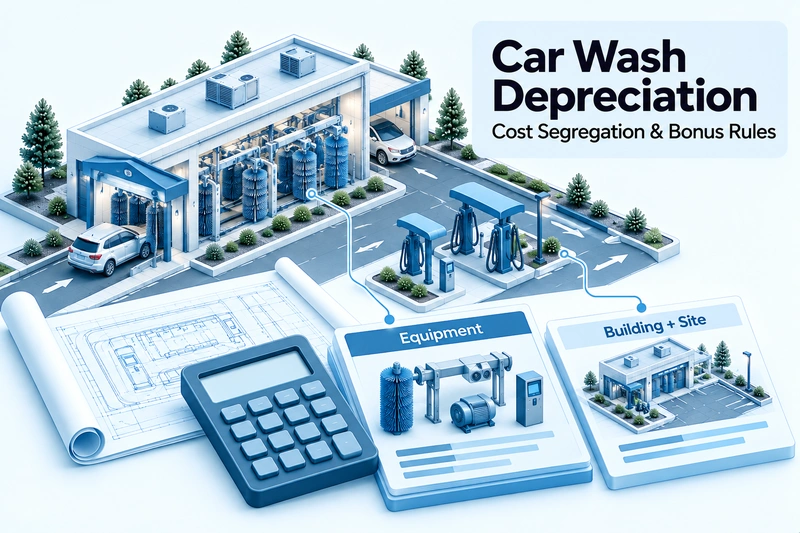
A car wash can contain more specialized business equipment and site work than a conventional commercial building. Tunnel equipment, dryers, payment hardware, vacuum equipment, dedicated process systems, paving, and exterior lighting may not follow the same recovery period as the building shell.
A cost segregation study evaluates those components individually. The goal is to assign each cost to the correct tax category, not to reach a predetermined reclassification percentage.
Car washes also have an important industry-specific rule. Revenue Procedure 87-56 Asset Class 57.1 expressly includes car wash buildings and related land improvements, generally giving them a 15-year recovery period and a 20-year class life. When the Section 168(k) requirements are met, that 15-year property may qualify for bonus depreciation. Separate office, convenience-store, or other non-wash buildings may instead remain 39-year property unless another classification applies.
The current 100% bonus-depreciation rule
Public Law 119-21 restored a permanent 100% additional first-year depreciation deduction for qualified property acquired after January 19, 2025. The IRS states that the rule applies to eligible depreciable property and provides elections and transition guidance in Notice 2026-11.
For a car-wash investor, three points matter:
- Acquisition date and placed-in-service date are different tests. Buying a property does not start depreciation if it is not yet ready and available for its intended use.
- Only qualified property receives bonus depreciation. Eligible property generally includes assets with a recovery period of 20 years or less. Land and ordinary 39-year building components do not qualify under that rule.
- The deduction is not mandatory in every case. A taxpayer may make applicable elections, including an election out by property class. The best choice depends on current income, expected future rates, state treatment, and the planned holding period.
- Used-property restrictions still apply. An existing car wash generally qualifies for bonus depreciation only if the taxpayer did not previously use the property and did not acquire it from a related party, along with the other requirements of Section 168(k)(2)(E)(ii).
Earlier phase-down percentages also depend on acquisition and placed-in-service facts, not merely the year a purchase agreement was signed. Investors should not apply a “2023 purchase equals 80%” or “2024 purchase equals 60%” shortcut without checking the transition rules.
What a car-wash study may classify
The IRS Cost Segregation Audit Technique Guide explains that cost segregation distinguishes shorter-life §1245 property from longer-life §1250 property. It also emphasizes documentation, cost reconciliation, asset function, and the legal support for each classification.
A car-wash study may evaluate:
- Wash tunnels, conveyors, dryers, pumps, chemical-dispensing equipment, vacuums, and payment hardware.
- Dedicated electrical, plumbing, and process connections that serve qualifying equipment rather than the building generally.
- Paving, curbs, exterior lighting, landscaping, drainage, and other depreciable site improvements.
- The car wash building, roof, walls, general electrical service, general plumbing, fire protection, and related land improvements, which generally fall within 15-year Asset Class 57.1 when they serve the car wash operation.
- Any separate office, convenience store, or other non-wash building that may remain 39-year nonresidential real property.
- Land, which must be separated from depreciable basis.
When an operating car wash is purchased as an applicable asset acquisition under Section 1060, the buyer and seller generally file Form 8594 and allocate consideration among the seven asset classes. The cost segregation study should reconcile to that purchase-price allocation. Goodwill, going-concern value, and covenants are generally 15-year Section 197 intangibles—not depreciable property—and cannot be reclassified as building, equipment, or land improvements.
These labels are not automatic tax conclusions. For example, a dedicated electrical circuit serving a wash tunnel may have different treatment from the building’s general electrical distribution system. A canopy may be a land improvement, equipment-related structure, or building component depending on its design and function. Drainage that serves the site may differ from plumbing that serves the building or the wash process.
That is why a defensible study should trace classifications to plans, invoices, cost records, photographs, and the property’s actual use. An inspection and engineering analysis can strengthen the support, but no study can guarantee an audit result.
An illustration of the first-year math
Assume an investor buys a car wash for $3,000,000, assigns $400,000 to land using appropriate support, and places the depreciable property in service in April 2025. Depreciable basis is therefore:
$3,000,000 − $400,000 = $2,600,000
Assume this is a mixed-use site with a car wash plus a separate convenience-store or office building, and that the completed study supports this allocation:
Under those assumptions:
- Five-year bonus deduction: $1,300,000 × 100% = $1,300,000.
- Fifteen-year bonus deduction: $1,000,000 × 100% = $1,000,000.
- Thirty-nine-year deduction: $300,000 × 1.819% = approximately $5,457.
- Total modeled first-year depreciation: $2,305,457.
The 1.819% building rate reflects an April placed-in-service date under the mid-month convention. IRS Publication 946 explains that nonresidential real property uses the mid-month convention and provides the applicable 39-year tables.
Without reclassification, the simplified first-year building deduction would be approximately:
$2,600,000 × 1.819% = $47,294
The modeled incremental first-year deduction relative to that simplified 39-year comparison is therefore:
$2,305,457 − $47,294 = $2,258,163
At an assumed 30% combined marginal rate, the current-year tax effect would be approximately $677,449 if the entire deduction is usable. The 39-year comparison is illustrative, not the correct treatment for a qualifying car wash building under Asset Class 57.1. This is a timing benefit, not a guaranteed permanent saving. Future depreciation will be lower, and a later sale may create recapture.
Can the owner use the deduction now?
Depreciation does not automatically offset every category of income. The answer depends first on how the car wash is operated.
An owner-operated car wash may be a trade or business rather than a rental activity. In that case, the loss is generally nonpassive only if the owner materially participates under Treasury Regulation Section 1.469-5T. A leased car-wash property may instead be a rental activity, subject to the rental rules and their exceptions. When the real estate is held in a separate entity and leased to a related operating company, the self-rental rule under Treasury Regulation Section 1.469-2(f)(6) generally recharacterizes net rental income as nonpassive but can leave a cost segregation loss passive unless the real-estate and operating activities are validly grouped under Treasury Regulation Section 1.469-4(d)(1).
Real Estate Professional Status is not a universal requirement for car-wash owners. It is primarily relevant when the loss arises from rental real estate. Even then, the taxpayer generally must materially participate in the rental activity for the loss to be nonpassive. IRS Publication 925 explains these distinctions and the separate tests for material participation and real estate professionals.
Other limits can also delay or restrict the deduction, including:
- Tax basis and at-risk limitations.
- Passive-activity loss rules.
- The excess business loss limitation for noncorporate taxpayers. For 2026, the Section 461(l) thresholds are $256,000, or $512,000 for a joint return, under Revenue Procedure 2025-32.
- Net operating loss rules.
- Business-interest limitations.
- Alternative Depreciation System requirements.
- Entity-level and owner-level allocation rules.
Before treating depreciation as cash savings, the owner’s tax advisor should model how much of the deduction can be used in the current year.
Look-back studies and Form 3115
A car wash already in service may still be eligible for a cost segregation study. The return history determines the correction method. If only one return was filed using the old method, the two-return rule generally calls for an amended return rather than Form 3115. After the method has been used on two or more returns, an eligible taxpayer may generally request an automatic change under Revenue Procedure 2025-23, designated change number 7, and calculate a Section 481(a) adjustment. Property placed in service before 2025 retains the bonus-depreciation rate applicable to its original acquisition and placed-in-service facts; a later study does not qualify it for the new 100% rate.
The catch-up amount is not simply the total newly identified short-life basis. It is generally the difference between depreciation allowed or allowable under the old method and the amount that would have been allowed under the corrected method through the beginning of the year of change.
The IRS Instructions for Form 3115 require depreciation-method applicants to complete Schedule E and document the property, placed-in-service year, asset class, recovery period, convention, and bonus-depreciation treatment.
A useful catch-up schedule should show:
- Depreciation reported on each prior return.
- Correct depreciation by asset class for each prior year.
- The difference for each year.
- The resulting net §481(a) adjustment.
- The current automatic-change authority and designated change number.
Form 3115 is not the correct answer in every situation. A one-year error, late election, disposed asset, or other special fact may require a different procedure. The return preparer should confirm the current filing method before the study is implemented.
State tax, recapture, and exit planning
Federal bonus depreciation does not determine the state result. The California Franchise Tax Board’s federal conformity summary states that California does not conform to the federal §168(k) bonus rules. The New York instructions for Form IT-225 generally require modifications for §168(k) property, subject to stated exceptions. The New Jersey CBT-100 instructions also require depreciation adjustments because the state has decoupled from federal bonus depreciation.
The applicable adjustment can vary by state, entity type, tax, and year. Investors should maintain separate federal and state depreciation schedules.
A sale can also produce depreciation recapture. Car wash equipment classified as Section 1245 property generally produces ordinary income to the extent of depreciation allowed or allowable, limited by the applicable gain. The car wash building and related site improvements are generally Section 1250 property. When 100% bonus depreciation is claimed on that 15-year Section 1250 property, nearly all of the deduction can be additional depreciation recaptured as ordinary income on sale, rather than gain eligible for the 25% maximum rate. Any remaining qualifying unrecaptured Section 1250 gain may be taxed at a maximum 25% rate for individuals. IRS Publication 544 explains both regimes and their limits.
After the TCJA, Section 1031 generally applies only to qualifying real property. Tunnel equipment, vacuums, and payment systems are personal property, so gain on those Section 1245 assets is generally recognized in the exchange year. The car wash building and qualifying site work may be eligible for exchange treatment, but Section 1250 ordinary-income recapture carries into the replacement property under Section 1250(d)(4) only to the extent the replacement property contains sufficient Section 1250 property. The federal Section 1031 real-property regulations use a separate real-property definition and apply detailed rules to components and incidental personal property.
The right economic comparison is therefore not “first-year deduction versus study fee.” It is the present value of earlier deductions, less study cost, lower future deductions, state adjustments, and expected tax on exit.
What percentage of my car wash will be accelerated?
There is no guaranteed universal percentage. Accelerating 60% or more can be realistic for some car washes because Asset Class 57.1 generally treats the wash building and related land improvements as 15-year property, while equipment may fall into even shorter recovery periods. Results still depend on land value, facility type, equipment ownership, separate non-wash buildings, purchase-price allocation, prior use, and the support available for each component. Treat any percentage quoted before document review as an estimate, not a tax conclusion.
A decision-focused next step
Before ordering a study, ask your tax advisor and study provider to confirm five items: depreciable basis, placed-in-service dates, estimated asset classes, current deduction usability, and expected holding period.
R.E. Cost Seg provides paid cost segregation studies. Any estimate should be treated as preliminary until the property records are reviewed and the classifications are supported. A useful proposal should show the assumptions, expected depreciation timing, and enough information for the investor and tax preparer to evaluate the result, not merely the largest possible first-year deduction.