A well-executed cost segregation study can convert a meaningful portion of an office building's purchase price or construction cost into first-year tax deductions, freeing capital for tenant build-outs, property upgrades, or your next acquisition. The size of that benefit depends on the building, your tax position, and current law, but for many owners, the year-one impact runs well into six figures.
In one engagement, we reclassified roughly a quarter of a Dallas-area office complex's depreciable basis, interior finishes, specialized lighting, parking-lot improvements, and millwork into shorter recovery periods. At the client's marginal rate, the first-year federal tax savings exceeded $200,000. Results vary materially with property mix, tax bracket, and the passive-activity rules discussed later in this article.
Office buildings are loaded with assets that wear out faster than the structure itself: carpet, cabinetry, decorative lighting, tenant build-outs, raised flooring, sidewalks, and parking lots. Without a study, the IRS default treats nearly everything as part of a 39-year nonresidential real-property class, even components that clearly do not last 39 years.
The Internal Revenue Code permits these components to be reclassified into 5-, 7-, or 15-year MACRS categories when supported by an engineering-based analysis. That, in turn, makes a large share of them eligible for first-year bonus depreciation under IRC §168(k), which the One Big Beautiful Bill Act (OBBBA) permanently restored at 100% for qualifying property acquired and placed in service after January 19, 2025.
R.E. Cost Seg works with office-building owners to identify and properly classify those components. On office properties, our engineering-based studies typically reclassify roughly 20% to 30% of depreciable basis into shorter-life categories, the low end of the broader 25%–40% commercial range, with the exact figure driven by tenant build-out intensity, site improvements, and specialty systems.
This article breaks down which office components qualify, how the math works under current law, and the rules that materially shape your net benefit.
Cost Segregation in the Context of Office Buildings
At its core, cost segregation is a method-of-accounting application of existing law (IRC §§ 167, 168, and the related regulations). It does not change the tax code; it applies it more precisely.
Instead of treating an entire building as a single 39-year asset, an engineering-based study identifies the §1245 personal property and §1250 land improvements within it, and places them in the correct shorter MACRS class, typically 5, 7, or 15 years.
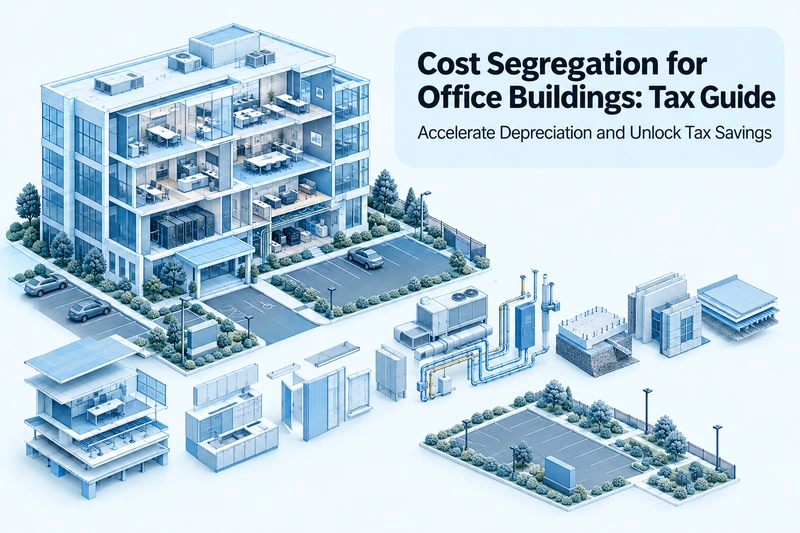
For an office building, these "faster" assets can include:
- Interior finishes, decorative millwork, and modular partitions
- Carpet and other non-permanent flooring
- Raised flooring for data cabling
- Decorative and task-specific lighting
- Specialized electrical serving specific equipment loads rather than the building generally
- Supplemental cooling dedicated to equipment rather than people (server rooms, labs). HVAC that heats or cools occupied space is a structural component of the building under Reg. §1.48-1(e)(2) and stays in the 39-year class no matter how it is zoned
- Sidewalks, parking lots, fencing, and site landscaping (15-year land improvements)
Do not overlook qualified improvement property. Improvements you make after acquiring the building: tenant build-outs, new ceilings and lighting, partitions, and interior HVAC distribution are generally qualified improvement property under §168(e)(6): 15-year recovery and 100% bonus, as long as they do not enlarge the building, add elevators or escalators, or touch the internal structural framework. For an office landlord, QIP is often a larger bucket than the 5- and 7-year personal property, because every landlord-funded build-out after acquisition qualifies (tenant-funded improvements belong to the tenant). This is why an office study pays off again with every major build-out.
The practical outcome is well-understood: accelerated depreciation produces larger deductions in the early years of ownership. That can free cash flow for capital improvements, tenant build-outs, or debt reduction, subject to the limitations described in the next section.
Why Office Building Owners Often Overlook This Strategy
Office assets tend to be viewed as "steady": long leases, consistent tenants, predictable cash flow. Because of that stability, many owners assume the tax treatment should also be simple, and rely on the default 39-year schedule without revisiting it.
In our experience, non-specialist CPAs often default to the 39-year rule for commercial buildings. It is safe and easy to document, but it leaves interior improvements, which actually wear out faster, locked in a 39-year recovery period.
Cost segregation addresses this by classifying components against the existing rules rather than by changing them. For office properties, it typically captures the items that support daily use but are not part of the building's core structure: modular conference-room walls, decorative lighting, raised flooring for data cabling, and certain HVAC distribution.
The Financial Impact, and the Rules That Shape It
Consider an office building with $5 million of depreciable basis (purchase price net of land), placed in service in mid-2025 by an investor who acquired it after Jan. 19, 2025 (so OBBBA's permanent 100% bonus depreciation applies).
Without cost segregation
- Straight-line over 39 years
- Annual deduction ≈ $128,000 (reduced in year one by the mid-month convention under IRS Publication 946)
With cost segregation + 100% bonus depreciation
- A study reclassifies 25% of basis ($1.25 million) into 5-, 7-, and 15-year classes
- Every asset with a recovery period of 20 years or less is bonus-eligible, so the full $1.25 million is deductible in year one; the only common exception is QIP where the owner has elected out of §163(j)
- Year-1 deduction ≈ $1.35M ($1,250,000 of bonus depreciation plus ~$96,000 of residual 39-year depreciation on the $3.75 million structure)
- Year-1 federal tax savings on a $1M deduction: ~$220K at the 22% bracket, ~$240K at 24%, ~$370K at 37%
These figures are illustrative. The actual benefit depends on several rules that the headline numbers do not capture:
Rules that materially affect your net benefit
- IRC §469 passive-activity loss limits. For investors who are not real-estate professionals (and outside the short-term-rental exception), accelerated losses can be suspended and carried forward until passive income is available or the property is sold. The Year-1 cash benefit may therefore be deferred.
- Excess business loss limit (§461(l)). Even a nonpassive, otherwise deductible loss is capped for non-corporate taxpayers at $256,000 single / $512,000 joint for 2026 (indexed). Anything above the cap carries forward as an NOL.
- Depreciation recapture at sale. Think in three buckets: §1245 personal property is recaptured as ordinary income (up to 37%); 15-year land improvements are §1250 property, but because 100% bonus far exceeds straight-line, the excess is also recaptured at ordinary rates; the 25% unrecaptured §1250 rate therefore applies mainly to the 39-year shell. For investors planning a near-term sale, recapture can absorb a meaningful share of the upfront benefit.
- IRC §163(j) interest-limitation election. A real-property trade or business that elects out of the §163(j) limitation must depreciate the building over 40 years under ADS and loses bonus depreciation on QIP. The 5-, 7-, and 15-year personal-property and land-improvement components keep their bonus eligibility, so QIP is the one class the election actually costs you, a real trade-off for a leveraged office owner with an active build-out program.
- OBBBA acquisition-date rule. Property under a binding written contract dated on or before Jan. 19, 2025, is treated as acquired on the contract date and may not qualify for the permanent 100% rate; even if placed in service later, it generally falls under the TCJA phase-down (40% in 2025, 20% in 2026, 0% in 2027 and after).
Used thoughtfully, cost segregation converts what would have been slow, decades-long depreciation into front-loaded deductions, which, after considering the rules above, can strengthen a property's near-term cash flow.
Common Misconceptions About Cost Segregation
A few persistent myths cause office owners to leave this strategy on the table.
- Myth: Cost segregation only works for new construction.
- Reality: A look-back study can capture missed depreciation on properties placed in service in prior years. The catch-up is claimed on the current return via Form 3115 (Application for Change in Accounting Method) as a §481(a) adjustment under the automatic-consent procedure in Rev. Proc. 2015-13 (automatic change number 7 under Rev. Proc. 2025-23), with no amended returns required. The test is whether the impermissible method has been used on two or more filed returns. If only one return has been filed on the wrong method, it is not yet a method of accounting and an amended return is the required path (Rev. Rul. 90-38).
- Myth: It is only worthwhile for very large commercial properties.
- Reality: With 100% bonus depreciation now permanent for qualifying post-Jan-19-2025 property, even office or medical suites in the $1 million range can produce meaningful first-year deductions. Study fees still need to be weighed against the expected benefit case-by-case, "meaningful" is not the same as "always profitable."
- Myth: A cost-segregation study automatically raises audit risk.
- Reality: A properly documented, engineering-based study is the methodology described in the IRS's own Cost Segregation Audit Techniques Guide (Pub 5653) and does not, on its own, elevate audit exposure. The IRS does, however, treat cost segregation as an examination focus area: poorly documented or "rule-of-thumb" studies are explicitly called out, and weak documentation can increase scrutiny.
In short, cost segregation is a standard, IRS-recognized method, not an aggressive loophole, when it is performed and documented to the standard the ATG describes.
Turning Tax Strategy Into Business Growth
The value of cost segregation is not just a larger Year-1 deduction. It is a sharper view of your property as a portfolio of assets with different useful lives, each with its own tax treatment, and a clearer line of sight to the cash that those treatments produce, after recapture and passive-activity rules are taken into account.
For office owners managing tight margins or planning renovations, the question is rarely whether cost segregation is permissible (it is), but whether the after-tax economics, given your bracket, your hold period, and your status under §469, justify the study. For most owners of buildings in the $1M+ range, the answer is yes; for some, it is not.
R.E. Cost Seg works with office-building owners to make that determination and, where it makes sense, to deliver an engineering-based study that meets the documentation standards the IRS sets out in Pub 5653. If you own or have recently renovated an office property, it is worth running the numbers under current law before another tax year closes.