What if a single rental house could generate tens of thousands of dollars in first-year tax deductions, enough to help finance upgrades on another unit and compound your returns? For landlords who qualify, that scenario is realistic.
In one recent engagement, R.E. Cost Seg helped a landlord with several single-family rentals across two states accelerate roughly $40,000 of first-year deductions by reclassifying flooring, appliances, lighting, and landscaping through an engineering-based cost segregation study.
Stories like this are increasingly common among residential landlords. Rental houses are loaded with shorter-life assets, appliances, carpet, driveways, fencing, and landscaping, that, without a study, often get lumped into the 27.5-year building basis.
With a properly executed cost segregation study, many of those components can be reclassified into shorter MACRS recovery periods (primarily 5-year personal property and 15-year land improvements), unlocking deductions years earlier than straight-line depreciation alone.
R.E. Cost Seg works with landlords and residential investors to identify which assets in a property qualify for accelerated depreciation. In our experience, engineering-based studies on a typical single-family rental commonly reclassify 20% to 30% of the depreciable basis into shorter-life categories, though the exact share varies meaningfully by property age, finish level, and improvements.
This article walks through which rental-house components actually qualify for accelerated depreciation under current IRS rules, how the 2025 tax law (OBBBA) changes the calculus, and the limits every landlord should understand before counting on the savings.
Why cost segregation matters for residential landlords
Residential rental real property is depreciated over 27.5 years under MACRS GDS.[1] Without a study, many landlords simply lump everything, cabinetry, appliances, driveways, into that 27.5-year building basis, even though IRS rules allow shorter-life components to be tracked separately.
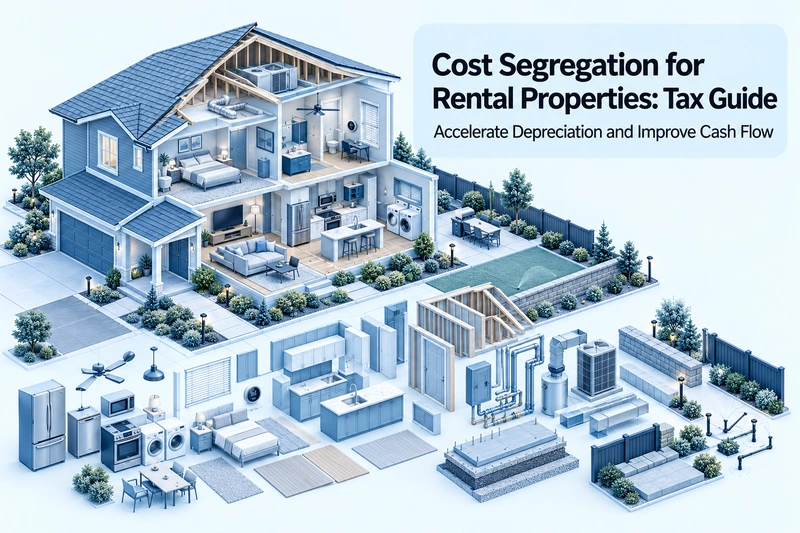
A cost segregation study identifies those components and assigns each to its correct recovery period. Common categories for a rental house include:
- 5-year personal property (e.g., appliances, carpet, certain removable fixtures)
- 15-year land improvements (e.g., driveways, landscaping, fencing)
- 27.5-year structural (the building shell and integrated systems)
The practical result is larger deductions earlier in the holding period, and, in most cases, stronger after-tax cash flow when it's most valuable.
The 2025 tax law (OBBBA) made this even more compelling
The One Big Beautiful Bill Act (OBBBA, Public Law 119-21, signed July 4, 2025) permanently restored 100% bonus depreciation for qualifying property with a recovery period of 20 years or less. The mechanics and transition rules are spelled out in IRS Notice 2026-11.[2]
Key dates and conditions every landlord should know:
- Property must be acquired and placed in service after January 19, 2025, to qualify for the permanent 100% rate.
- Property placed in service between January 1 and January 19, 2025, is eligible only for a transitional 40% bonus rate.
- Property under a written binding contract entered into before January 20, 2025, is treated as acquired on the contract date and stays on the TCJA phase-down by placed-in-service year: 40% in 2025, 20% in 2026, and 0% in 2027 and after.
- State conformity varies. Several states (e.g., California, New Jersey, New York) decouple from federal bonus depreciation, so federal savings ≠ total savings.
A worked example (with realistic caveats)
Assume a landlord buys a rental house with a depreciable building basis of $400,000, meaning land value has been carved out of the purchase price (land itself is not depreciable):
- Straight-line depreciation: $400,000 ÷ 27.5 ≈ $14,545/year (subject to the mid-month convention in year 1).
- With cost segregation applied, say a study identifies $100,000 of short-life property eligible for 100% bonus:
- First-year deduction on that $100,000 = $100,000.
- Federal tax impact at a 32% marginal rate: $100,000 × 32% = $32,000 of federal income tax reduction if the loss is usable (see next section). State tax and the 3.8% Net Investment Income Tax (NIIT) may further increase or reduce the benefit.
Critical caveat: passive-activity loss limits (IRC §469). Rental losses are generally passive and cannot offset W-2 or other active income. For most landlords, the headline first-year deduction only translates into immediate cash tax savings if one of the following applies:
- The landlord qualifies for Real Estate Professional Status (REPS), 750+ hours, and >50% of personal services in real property trades or businesses, and material participation in the rental activity.
- The property qualifies under the short-term rental (STR) exception, average guest stay of 7 days or less (or 30 days with substantial services), with material participation.
- The landlord has other passive income to absorb the loss, or the special $25,000 active-participation allowance applies (phased out between $100k–$150k MAGI).
Without one of these, the deduction is suspended and carried forward, still valuable, but not immediate.
Second gate: the excess business loss limit (§461(l)). Even when the loss is nonpassive because of REPS or STR status, non-corporate taxpayers can only use net business losses against wages and investment income up to $256,000 single / $512,000 joint for 2026 (indexed). Anything above the cap carries forward as an NOL.
What can be reclassified in a rental house
A well-executed study breaks the property into components and assigns each to the correct asset recovery period under MACRS. The classifications below reflect typical treatment for a residential rental house under current IRS guidance (IRS Pub. 946).
5-year property (personal property)
- Appliances: refrigerators, dishwashers, washers, dryers, microwaves, ranges
- Carpet, vinyl, and other non-permanent flooring
- Window coverings and blinds
- Removable light fixtures and ceiling fans (where not integrated into the building's electrical system)
- Furniture used in a residential rental (per IRS Pub. 527 Table 2-1, furniture used in rental activities is 5-year property, not 7-year)
- Smart-home devices that are not part of the building's core electrical system
Note on cabinets and countertops: Built-in kitchen and bathroom cabinets and countertops in a residential rental are generally treated as structural components depreciated over 27.5 years, not 5-year personal property. The IRS Cost Segregation Audit Techniques Guide (Pub. 5653) treats components of this kind as structural unless the specific facts show otherwise. Only removable or non-structural cabinetry/millwork may qualify for shorter recovery, and even then, the facts must support §1245 treatment. Aggressive 5-year reclassification of built-in cabinetry is a common audit flag.
Note on small purchases: the $2,500 de minimis safe harbor (Reg. §1.263(a)-1(f)) lets a landlord expense separately purchased appliances and fixtures outright, with no study required. It does not apply to allocating a purchase price among components, which is exactly what a cost segregation study is for.
15-year property (land improvements)
- Driveways, walkways, and patios
- Landscaping, fencing, retaining walls
- Site lighting and irrigation systems
27.5-year property (structural)
- Framing, roofing, foundations, exterior walls
- Plumbing mains and integrated electrical
- Central HVAC integrated into the building (window units and equipment dedicated to specific personal property may be §1245)
- Built-in cabinets, countertops, and other components affixed to the building
7-year property, usually not relevant for a rental house
The 7-year MACRS class (Asset Class 00.11) covers office furniture and fixtures and is rarely applicable to a typical single-family rental. If you see a study assigning meaningful basis to 7-year property in a residential rental, ask the preparer to document the specific facts.
Qualified Improvement Property (QIP), does not apply to residential rentals
A frequent source of confusion: QIP under IRC §168(e)(6) applies only to interior improvements to nonresidential real property. Residential rental buildings (including single-family and multifamily rentals) are excluded by statute. If your investment includes a nonresidential component, for example, retail or office space in a mixed-use building, QIP may apply to that portion, and OBBBA's permanent 100% bonus makes it especially attractive. But for a pure rental house, QIP is not the right framework.
When and how to commission a study
Cost segregation is most effective when timed strategically. Common triggering events for landlords:
- Acquisition of a new property. Applying a study in the year of purchase lets you take bonus depreciation against the largest available basis.
- Completion of a significant renovation. Improvements such as kitchen remodels, flooring replacement, or landscaping can be reclassified for accelerated recovery.
- A high-income year, REPS year, or year of STR qualification. Timing the study (or a look-back) into a year when the deduction is actually usable amplifies the benefit.
- Existing property held without a prior study. A look-back study can capture missed depreciation in the current year using Form 3115 and a §481(a) adjustment, without amending prior returns. Two details matter: the two-return rule (if only one return has been filed on the wrong method, amend it; Form 3115 applies once two or more returns have been filed, as automatic change number 7 under Rev. Proc. 2025-23), and the fact that the catch-up uses the bonus rate in effect the year the property was originally placed in service, not today's 100%.
A professional study typically includes:
- A site inspection and photographic documentation of assets
- Review of construction records, invoices, closing statements, and plans
- Engineering-based cost modeling allocating basis among asset classes
- A defensible report suitable for IRS review under the IRS Cost Segregation Audit Techniques Guide
Study fees vary, typically a few thousand dollars for a single-family rental, more for portfolios, and should be weighed against expected first-year savings that the landlord can actually use given §469.
Illustrative look-back: In a recent engagement, a client who had owned a rental duplex for five years without a study had roughly $80,000 of reclassifiable basis identified. Using Form 3115 and a §481(a) adjustment, the client was able to claim the cumulative catch-up deduction in the current year, rather than amending prior returns. The cash impact depended on the client's REPS status and other facts. (Illustrative, not a guarantee.)
Depreciation recapture: read this before you sell
A common misconception is that depreciation recapture on accelerated assets is capped at 25%. It is not. The 25% cap applies to unrecaptured §1250 gain, i.e., straight-line depreciation on the real-property (building) portion.(IRS Publication 544)
For the §1245 personal property identified in a cost segregation study (appliances, carpet, removable fixtures), depreciation recapture on sale is taxed as ordinary income, up to 37% federally under current rates.
Land improvements are a separate case. Driveways, fencing, landscaping, retaining walls, and site lighting are §1250 property (depreciable real property other than a building), which is precisely why they sit in the 15-year class rather than 5- or 7-year. A cost-segregated rental house therefore has three recapture buckets at sale:
- 5-year §1245 property. All depreciation taken, bonus included, is recaptured as ordinary income, up to 37%.
- 15-year land improvements (§1250). The excess of accelerated depreciation over straight-line, which with 100% bonus is nearly all of it, is ordinary "additional depreciation" under §1250(b). Only the straight-line portion is unrecaptured §1250 gain at 25%.
- 27.5-year building. Straight-line only, so the entire amount is unrecaptured §1250 gain, capped at 25%.
NIIT follows the same split in spirit: for a passive landlord the 3.8% NIIT applies to the recapture as well, because the gain is net investment income, while a REPS landlord's gain from a rental trade or business is generally outside NIIT.
That doesn't mean cost segregation is a bad deal. The time value of money, the ability to use deductions against active income (for REPS or STR-qualifying investors), and the option to defer recapture via a §1031 exchange or hold-until-death step-up often outweigh the back-end cost. But the comparison should be modeled, not assumed, on a property-by-property basis.
Common misconceptions and compliance risks
A quick reality-check on the most common CPA objections and myths we see:
- "It's only for commercial buildings." Residential rentals can absolutely benefit, as long as the landlord can use the deductions under §469 or has the income to absorb them.
- "Recapture will be capped at 25%." Wrong, see above. §1245 recapture is ordinary-income.
- "I can DIY with software." Spreadsheet or template studies lacking engineering documentation and asset-level classification are vulnerable to disallowance under IRS audit techniques.
- "It's too small to matter." Even a single rental can yield meaningful accelerated deductions under 100% bonus, but always model the usable benefit, net of passive-loss limitations and state non-conformity.
- "All cabinets and countertops are 5-year property." Built-in residential cabinetry and countertops are generally structural (27.5-year). Treating them as 5-year is an audit flag.
- "QIP applies to my rental house." It doesn't, QIP is for nonresidential property.
Turning deductions into investment leverage
Done right, cost segregation isn't just about lowering taxes; it's about improving the financial velocity of a real-estate portfolio. With 100% bonus depreciation permanently restored under OBBBA, well-timed studies can free up capital for additional acquisitions, renovations, or reserves, when the deductions can actually be used.
The benefit materializes only when:
- The study is engineering-based and defensible.
- The landlord's tax profile (REPS, STR, other passive income, or basis carryforwards) lets the deduction reduce current-year tax.
- The post-sale recapture math has been modeled honestly.
For landlords exploring how cost segregation fits their rental houses under the new OBBBA rules, R.E. Cost Seg offers engineering-driven analysis that identifies every qualifying asset with accuracy and compliance in mind. Get a free proposal to see exactly what a study would identify for your portfolio, or run the numbers yourself with our cost segregation calculator.