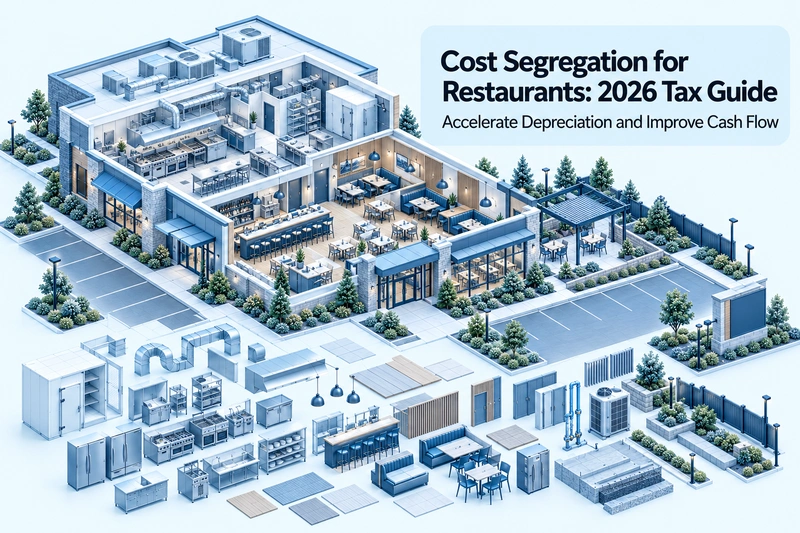
What if your restaurant renovation could generate hundreds of thousands of dollars in accelerated deductions, enough to fund expansion, pay down debt, or smooth seasonal swings? In one R.E. Cost Seg engagement, a multi-unit operator who completed a $1.2 million renovation on their flagship location reclassified kitchen systems, flooring, HVAC, and custom millwork through a cost segregation study and accelerated more than $400,000 of basis into shorter-life categories.
Stories like this are common in restaurant cost segregation because restaurants are dense with fast-depreciating assets, walk-in coolers, exhaust hoods, specialized plumbing, tile, booths, bar finishes, and decorative lighting. Without an engineering study, the IRS default is to depreciate the building (and most attached improvements) on a 39-year straight-line schedule, even for components that clearly do not last that long.
Here is what matters: IRS rules and IRC §168 let you reclassify many of these components into 5-year personal property, 15-year land improvements, and 15-year Qualified Improvement Property (QIP) under IRC §168(e)(6). The 7-year class applies in limited cases (for example, certain office furniture and fixtures) and is generally a small share of a restaurant study. Instead of waiting decades to recover your investment, you can claim substantial deductions immediately, and, under current law, often expense those reclassified components 100% in year one through bonus depreciation (see the OBBBA section below).
R.E. Cost Seg specializes in working with restaurant owners, operators, and investors. Our engineering-based studies typically reclassify 20% to 35% of a restaurant's depreciable basis into shorter-life categories, consistent with industry-wide ranges of roughly 20–40% reported by peer advisory firms for restaurant properties. This article breaks down which restaurant components qualify, the rules that govern them in 2026, and what it means for your bottom line.
The Quick Take: How Cost Segregation Boosts Cash Flow
At its core, cost segregation is the process of identifying and reclassifying certain building components into shorter depreciation categories. Instead of depreciating the entire restaurant over nearly four decades, you separate the parts that wear out faster, such as flooring, lighting, kitchen equipment, specialized plumbing, signage, landscaping, and parking, so you can deduct them sooner.
The immediate effect is accelerated depreciation, which front-loads tax deductions and improves cash flow. For restaurant owners and investors, that means more working capital to reinvest in expansion, pay down debt, or absorb seasonality.
Industry studies report that cost segregation typically unlocks 20% to 40% of a restaurant property's depreciable basis in shorter-life categories, toward the upper end of the 25–40% range typical for commercial property. For a $1 million buildout, a 20–35% reclassification means $200,000 to $350,000 of basis moved into 5-, 7-, or 15-year classes, and, under current 100% bonus depreciation rules, much of that can be expensed in year one (model the numbers with our cost segregation calculator).
Depreciable basis ≠ purchase price: Depreciable basis excludes the value of land (which is never depreciable). When you read a "20–35%" figure, it refers to the building's depreciable basis, not the full acquisition cost.
It is not about avoiding tax; it is about timing deductions strategically so cash flow supports growth.
Bonus Depreciation in 2026: What the OBBBA Changed
The single most important fact for any restaurant owner considering cost segregation in 2026 is the One Big Beautiful Bill Act (OBBBA), enacted in July 2025, which amended IRC §168(k).
Key points:
- The OBBBA permanently restored 100% first-year bonus depreciation for qualified property (generally tangible property with a recovery period of 20 years or less) acquired and placed in service after January 19, 2025.
- Property under a written binding contract entered into before January 20, 2025 is treated as acquired on the contract date and falls under the prior phase-down schedule at the rate for its placed-in-service year: 40% for all of 2025, 20% in 2026, and 0% in 2027 and after.
- IRS Notice 2026-11 provides interim guidance on "acquired" and "placed in service" rules under the amended §168(k).
- The OBBBA also created IRC §168(n) Qualified Production Property (QPP), a separate 100% expensing provision for certain U.S. manufacturing/production buildings. QPP is narrowly defined and generally does not apply to restaurants, but adjacent food-production facilities may want to evaluate it.
What this means for restaurant cost segregation: Every dollar of basis that an engineering study moves into the 5-, 7-, or 15-year class (including QIP at 15 years) is generally eligible for 100% first-year bonus depreciation if the property is acquired and placed in service after January 19, 2025. That is a dramatic improvement over the 40% rate that applied to property placed in service earlier in 2025 and the 20% rate that had been scheduled for 2026.
Qualified Improvement Property (QIP): The Restaurant-Specific Bucket
Most restaurant operators do not realize how much of their interior buildout falls into Qualified Improvement Property under IRC §168(e)(6). QIP is:
- An improvement to the interior portion of a nonresidential building,
- Made by the taxpayer (improvements acquired with the building generally do not qualify),
- Placed in service after the building was first placed in service, and
- Excludes building enlargements, elevators, escalators, and internal structural framework.
QIP carries a 15-year MACRS recovery period and, under OBBBA-amended §168(k), qualifies for 100% bonus depreciation when placed in service after January 19, 2025. This is the modern successor to the old "qualified restaurant property" 15-year class that TCJA consolidated in 2017 (and that CARES Act technical corrections finally restored at 15 years in 2020). One difference matters: the old class also covered restaurant buildings. QIP does not. An acquired or newly built restaurant building is 39-year property today, and only interior improvements made after the building was first placed in service land in the 15-year QIP class.
For restaurants, QIP typically captures interior non-structural elements like drywall, ceilings, interior doors, plumbing within the building shell, electrical, and interior HVAC distribution (subject to the §168(e)(6) exclusions). Rooftop units and other components outside the interior of the building are not QIP; they stay in the 39-year class unless they independently qualify as §1245 property. A cost segregation study identifies which interior costs qualify for QIP at 15 years versus which belong in the 5-year personal-property class or remain in the 39-year shell.
Why Cost Segregation Matters More in the Restaurant Industry
Restaurants are among the most capital-intensive small-business categories (anecdotally, no Tier 1 government dataset ranks them definitively). Each buildout or renovation involves hundreds of line items, from walk-in coolers and hoods to tile, booths, and bar finishes. Unlike a traditional office, these assets often have shorter useful lives and frequent replacement cycles.
That combination makes restaurants strong candidates for cost segregation.
Factors that amplify the benefit:
- Heavy equipment load. Kitchen systems, wiring, and specialized plumbing represent a large share of total project costs.
- Frequent remodeling. Many franchise systems require periodic remodels, often on multi-year cycles defined in the franchise agreement.
- Leasehold improvements. Tenant-funded buildouts can qualify the tenant for accelerated depreciation (including QIP), provided the improvements were made by the taxpayer and meet §168(e)(6).
- Cash flow sensitivity. With slim margins and seasonality, improved liquidity from accelerated deductions can stabilize operations.
For operators expanding through new locations or renovations, cost segregation can turn a static tax position into a dynamic financial lever, especially when paired with 1031 exchanges or bonus depreciation.
Breaking Down the Process: What a Cost Segregation Study Includes
An engineering-based cost segregation study analyzes construction or acquisition costs and reclassifies them into asset categories with different depreciation lives under IRS rules. The IRS's Cost Segregation Audit Techniques Guide (Publication 5653) is the canonical reference for what "good" looks like.
The process typically looks like this:
- Engagement and scoping. Engage a firm that pairs cost segregation specialists with CPAs, construction engineers, and valuation experts.
- Document review. The team gathers architectural plans, invoices, change orders, and cost data from construction or acquisition.
- Site analysis. Engineers inspect the property (virtually or on-site) to identify components qualifying for shorter depreciation, decorative finishes, custom lighting, dedicated kitchen HVAC, signage, parking, landscaping, etc.
- Cost allocation. Each component is assigned a value and reclassified under IRS-defined property classes (5-year, 7-year limited, 15-year land improvements, 15-year QIP, 39-year shell).
- Report and filing. The resulting report supports adjusted depreciation schedules, and, for prior-year property, supports a Form 3115 accounting-method change (see "Look-back studies" below).
Pub. 5653 explicitly notes that studies prepared by qualified construction engineers are generally more reliable than non-engineering "residual" or template studies.
Fees vary widely by scope, property size, and provider. Engineering-based studies on a small single-location restaurant commonly run roughly $3,000 to $5,000, with larger or more complex properties up to about $15,000 and multi-unit projects scaling from there. The ROI is typically strong, many operators recover the fee several times over in the first year alone.
Strategic Considerations for Owners and Investors
- For owner-operators: Accelerated deductions reduce taxable income in the early years when debt service and startup costs are highest, freeing cash for staffing, marketing, or new equipment.
- For multi-unit or franchise owners: Scale multiplies the benefit. Conducting studies across multiple sites compounds tax savings, and predictable franchise remodel cycles let you plan the timing in advance.
- For real estate investors leasing to restaurant tenants: Cost segregation enhances after-tax yield, if you can actually use the deductions. See the next section on passive activity rules.
- For buyers and developers: When acquiring an existing restaurant, a look-back study plus Form 3115 can retroactively capture missed depreciation as a current-year catch-up (see below).
Passive Activity Rules: A Critical Filter for Investors
For investors who own restaurant real estate but do not operate the restaurant, accelerated deductions are often passive losses under IRC §469. Passive losses can only offset passive income; they cannot offset W-2 wages, active business income, or portfolio income, unless one of several exceptions applies:
- Real Estate Professional Status (REPS) under IRC §469(c)(7): requires more than 750 hours and more than half of personal services in real property trades or businesses, plus material participation in the rental activity.
- Short-term rental exception: average customer stay of 7 days or less can convert the activity out of the §469 "rental" definition (generally not applicable to restaurant real estate).
- Active operator: restaurant owner-operators who materially participate in the restaurant business typically can use the deductions against operating income.
- $25,000 special allowance for active participation in rental real estate (phases out above $100,000–$150,000 modified AGI).
A second cap applies to everyone, not just investors. Under §461(l), non-corporate taxpayers can use net business losses against wages and investment income only up to $256,000 single / $512,000 joint for 2026 (indexed). Anything above the cap carries forward as an NOL. This bites owner-operators as readily as passive investors.
If you hold the building in an LLC and lease it to your own restaurant, the rental is passive per se under §469(c)(2), no matter how hard you work in the restaurant. The exit is the grouping election under Reg. §1.469-4(d)(1): group the rental with the operating business when both are owned in the same proportion, and the rental losses then follow your material participation in the restaurant. Note the flip side, the self-rental rule in Reg. §1.469-2(f)(6): net rental income from a lease to a business you materially participate in is recharacterized as nonpassive, so the lease cannot be used to generate passive income that absorbs other passive losses.
Before commissioning a study, model whether you can actually deduct the loss in the current year. Suspended passive losses carry forward, but they do not produce current-year cash savings.
Managing Risk and Compliance
Cost segregation is entirely legitimate under IRS guidelines when executed properly. Compliance pointers:
- Use a qualified provider. The IRS Audit Techniques Guide (Pub. 5653) describes the engineering-based detailed approach as the most reliable. Generic or template reports invite IRS audit scrutiny.
- Document everything. Retain the cost segregation study, invoices, change orders, and construction records for the life of the asset plus the period of limitations after disposition. For a 39-year building, that can be 30+ years. The common "seven-year" rule of thumb for general business records does not apply to depreciable property records.
- Be mindful of recapture:
- §1245 property (the 5- and 7-year reclassified items): all depreciation claimed, bonus included, is recaptured as ordinary income on sale.
- 15-year property (land improvements and QIP) is §1250 property, not §1245. §1250 recaptures "additional depreciation," the excess over straight-line, as ordinary income, and with 100% bonus nearly all of it is excess. Only the straight-line portion is unrecaptured §1250 gain at a maximum 25% rate.
- The 39-year shell: straight-line only, so the entire amount is unrecaptured §1250 gain, capped at 25%.
- C-corporation owners also face §291, which converts 20% of the straight-line §1250 depreciation into ordinary income.
- Your CPA should model every bucket before a sale, refinance, or 1031 exchange.
- Coordinate with 1031 exchanges. If you are rolling gains into new restaurant properties, align the study with your exchange strategy and basis carryover.
- Mind state conformity. Many states decouple from federal bonus depreciation and require add-backs. Federal benefits do not automatically flow through at the state level.
- Watch §163(j). Highly leveraged operators may be subject to business-interest-expense limits, with ATI add-backs that interact with depreciation deductions.
When executed properly, cost segregation is not aggressive, it is just well-documented planning.
Look-Back Studies: Form 3115 vs. Amended Returns
If you have owned a restaurant property for several years and never performed a cost segregation study (see our deeper dive on look-back studies), you have two paths:
- Form 3115 (Application for Change in Accounting Method) with an IRC §481(a) adjustment. This is the most common approach. It is filed with your current-year return and produces a one-time catch-up deduction in the current year equal to the depreciation you should have taken minus what you did take. It does not produce refunds for prior years, the entire benefit flows through the current return.
- Amended returns. If the property has appeared on only one filed return, the treatment is not yet an adopted method of accounting, and amending that return within the statute of limitations is the path to take.
Which path applies is not a matter of preference. Once the property has been depreciated the same way on two consecutive returns, that treatment is an adopted method of accounting and can be changed only prospectively, through Form 3115 (Reg. §1.446-1(e)(2)(ii)(d); Rev. Rul. 90-38). Amending prior returns at that point would be a retroactive method change without consent, which the regulations do not permit. So: one return filed, amend it; two or more, file Form 3115 as automatic change number 7 under Rev. Proc. 2025-23 and take the §481(a) catch-up on the current return. The §481(a) adjustment can be a deduction (favorable) or income (unfavorable), and for missed cost segregation it is almost always a deduction.
Turning Tax Savings Into Growth
What makes cost segregation powerful is not just the tax benefit, it is what you do with the freed-up cash. Restaurant operators frequently redeploy savings into new locations, talent, or systems that improve long-term profitability.
If your business strategy includes scaling into new markets, launching delivery-first concepts, or professionalizing operations, R.E. Cost Seg can help structure the study to match the plan, get a free proposal to model the numbers on your specific property. The tax strategy is the first move; the real advantage comes when you reinvest that capital, wisely and quickly, into the people and systems that turn savings into scale.