What if a warehouse acquisition could generate a six- or seven-figure first-year tax deduction, enough to offset a meaningful portion of debt service or fund equipment purchases? In the right circumstances, it can, and the mechanism is well established in federal tax law. The example below illustrates the math; it is not a guaranteed outcome.
Here’s an example: A 120,000-square-foot distribution warehouse with $5M of depreciable basis, after land has been excluded. A detailed, engineering-based cost segregation study reclassifies roughly 30% of that basis ($1.5M) into 5-, 7-, and 15-year property. If the property qualifies for 100% bonus depreciation (see the rules below), the full $1.5M can be deducted in Year 1. At a blended 30% federal/state effective rate, that is approximately $450,000 in first-year tax savings, before any §469 passive-loss, §461(l) excess-business-loss, §163(j) interest-limitation, or depreciation-recapture considerations.
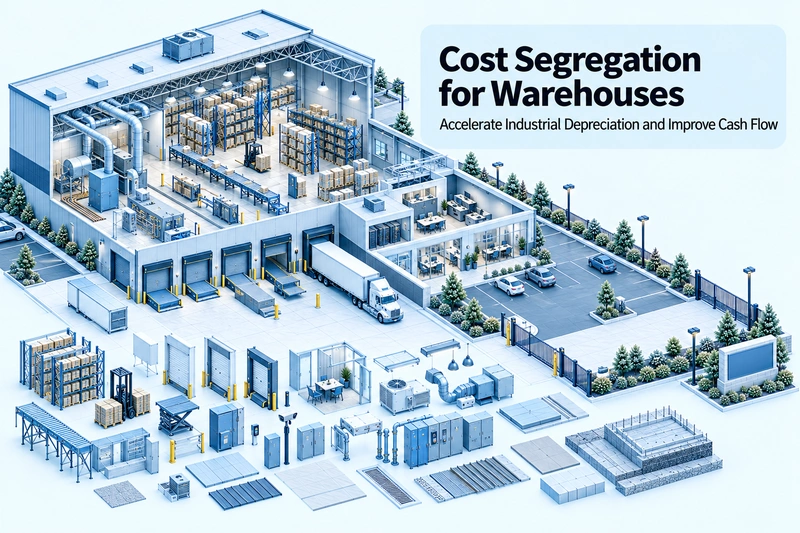
Warehouses are loaded with assets the IRS itself treats as shorter-lived than the building shell: certain lighting, dock equipment, process-dedicated electrical, equipment foundations, paving, fencing, and site improvements. Without an engineering study, these components default to the 39-year nonresidential real-property recovery period under IRC §168(c) and IRS Publication 946.
With a cost segregation study, qualifying components can be reclassified into 5-, 7-, or 15-year MACRS categories, but whether a given component qualifies is a facts-and-circumstances determination governed by IRC §1245 vs. §1250, the IRS Cost Segregation Audit Techniques Guide (ATG), and case law, including Hospital Corp. of America v. Commissioner, 109 T.C. 21 (1997).
How Cost Segregation Applies to Industrial Properties
A cost segregation study examines every component of a building and identifies items that meet the Hospital Corp. / Whiteco factor test for §1245 personal property, or that fall within Rev. Proc. 87-56 Asset Class 00.3 (land improvements, 15-year). The reclassification accelerates depreciation deductions into the early years of ownership; it does not create new deductions.
Components that are commonly (but not universally) reclassifiable in a warehouse:
- Lighting that primarily serves task or process functions rather than general building illumination
- Concrete aprons, parking areas, fencing, and other 15-year land improvements (Rev. Proc. 87-56, Class 00.3)
- Dock levelers, lifts, and conveyor systems that are §1245 personal property
- Office build-outs and tenant improvements that meet the Qualified Improvement Property definition under IRC §168(e)(6) (15-year)
- Process-dedicated ventilation, fume hoods, and dust collection that serve specific equipment (not the building envelope)
- Branch electrical distribution that directly powers §1245 process equipment
- Site paving, curbs, storm drainage, and fencing (15-year land improvements)
§1245 vs. §1250 matters: Only the portion of a system that primarily serves §1245 process equipment can be reclassified to 5- or 7-year property. The portion serving the building envelope (general HVAC, life-safety, base building electrical) remains §1250 real property at 39 years. The IRS Cost Segregation ATG (Chapters 4 and 7) is the controlling reference, and exam teams apply the Hospital Corp. / Whiteco factors.
What a Warehouse Cost Segregation Study Typically Yields
Industry literature commonly reports reclassification ranges of roughly 15% to 40% of depreciable basis for industrial properties, depending on the facility's age, use, electrical and HVAC complexity, and site work. That range is wide. Bulk distribution buildings are mostly shell and often land at the low end, roughly 10% to 25%. The 30% used in the example below assumes a facility with meaningful process electrical, dock equipment, and site work. The IRS does not endorse any specific range, and results vary materially by property.
Worked example (illustrative, assumptions disclosed):
Important assumptions in this example: (1) Property was both acquired and placed in service after January 19, 2025, with no binding written contract dated before January 20, 2025. (2) Owner has sufficient passive or non-passive income to absorb the deduction (otherwise IRC §469 may suspend losses). (3) Owner is not constrained by the IRC §163(j) business interest limitation. (4) State of operation conforms to federal bonus depreciation (California, New York, Illinois, Connecticut, and several others do not). (5) Owner is not limited by the IRC §461(l) excess business loss cap ($256,000 single / $512,000 joint for 2026, with the excess carried forward as a net operating loss). (6) Future depreciation recapture at disposition is taxed at ordinary rates on §1245 components (up to 37% federal for individuals). Change any of these assumptions, and the net benefit moves materially.
The Current Bonus Depreciation Rules (Post-OBBBA)
The One Big Beautiful Bill Act (P.L. 119-21, signed July 4, 2025) permanently restored 100% bonus depreciation under IRC §168(k), and the IRS issued interim guidance in Notice 2026-11. The rule is more nuanced than "placed in service after January 19, 2025":
- Property must be both acquired and placed in service after January 19, 2025 to qualify for the permanent 100% rate.
- Property under a written binding contract dated before January 20, 2025 remains subject to the prior TCJA phase-down, regardless of when it is placed in service: 40% for 2025 placed-in-service, 20% for 2026, 0% beginning in 2027.
- A short window, property placed in service between January 1 and January 19, 2025, qualifies for 40% bonus depreciation under the transitional rule.
- Used property still qualifies (since TCJA), provided the acquisition meets IRC §168(k)(2)(E)(ii).
Bonus depreciation summary (current law, post-OBBBA):
- Acquired and PIS after Jan. 19, 2025 → 100%, permanent
- Acquired before Jan. 20, 2025, PIS in 2025 → 40%
- Acquired before Jan. 20, 2025, PIS in 2026 → 20%
- Acquired before Jan. 20, 2025, PIS in 2027+ → 0%
Qualified Production Property: A Bigger Lever Than Cost Segregation
OBBBA also added IRC §168(n), a 100% first-year deduction for the building itself, not just its components. Qualified production property is nonresidential real property used as an integral part of a qualified production activity, meaning the manufacturing, production, or refining of tangible personal property. To qualify, construction must begin after January 19, 2025 and before January 1, 2029, the property must be placed in service before 2031, and the taxpayer must make an election.
Pure storage and distribution warehouses do not qualify, and office, sales, and administrative space is carved out. A warehouse that is integral to an on-site manufacturing operation may qualify, and where it does, §168(n) moves the math more than any cost segregation study. Note the recapture trap: qualified production property disposed of within 10 years of being placed in service, or whose use changes within that window, is subject to recapture.
Commonly Overlooked Opportunities in Industrial Facilities
Even experienced owners miss assets that may qualify. The categories below are candidates for reclassification; eligibility always depends on facts and circumstances, supported by engineering documentation that meets the 13 principal elements of a quality study in the IRS ATG.
1. Electrical and power distribution serving process equipment. Branch circuits, subpanels, and transformers that primarily serve §1245 process equipment (production lines, refrigeration condensers, machinery) may be reclassified to 5- or 7-year property under MACRS asset class 57.0 or industry-specific classes. General building electrical service remains §1250 / 39-year.
2. Equipment foundations and embedded process features. Separate foundations and pads poured solely to support specific equipment, and trench drains or embedded rails that serve a specific process, can be §1245 property. The building floor slab remains a structural component under Reg. §1.48-1(e)(2) even where it was thickened or reinforced to carry equipment loads, and the ATG treats it that way. Epoxy coatings are generally treated as part of the floor unless they are removable.
3. Process-dedicated HVAC and ventilation. Climate-controlled zones, fume hoods, and dust collection that serve specific equipment (not the building envelope) are typically eligible for shorter recovery periods. Central HVAC serving the whole building stays at 39 years.
4. Information systems and security. Network cabling generally qualifies as 5-year property under Rev. Proc. 87-56 Class 00.12 (Information Systems). Surveillance and card-access systems are facts-and-circumstances: depending on integration with life-safety, they can be 5-, 7-, or 39-year. Practitioners and exam teams sometimes disagree here, so documentation matters.
5. Site improvements. Asphalt paving, curbs, sidewalks, storm drainage, fencing, and exterior lighting are 15-year land improvements under Rev. Proc. 87-56 Class 00.3, not non-depreciable land.
When to Commission a Cost Segregation Study
- After new construction or expansion. Conducting a study before the first tax filing captures bonus depreciation on qualifying assets in Year 1.
- On acquisition of an existing property. If the property has been on an impermissible method for two or more tax years, a look-back study can catch up the missed depreciation in the current year via a Form 3115 accounting-method change and a §481(a) adjustment under Rev. Proc. 2015-13 and Rev. Proc. 2025-23 (DCN 7), no amended returns needed. If the property has been depreciating for only one tax year, the correction must be made by amending the prior return.
- Following major upgrades. New refrigeration units, dock bays, or lighting retrofits can warrant an updated study.
- During tenant build-outs. Owner-funded interior improvements to nonresidential buildings may qualify as Qualified Improvement Property under IRC §168(e)(6), depreciable over 15 years and bonus-eligible.
Form 3115 caveats: Method changes are not available while the property is under IRS examination (with limited exceptions), and the same DCN-7 change generally cannot be repeated within a 5-year window. Coordinate timing with your CPA before filing.
Mistakes Owners Make and How to Avoid Them
- Treating process-dedicated systems as part of the building shell. Electrical or HVAC designed for specific operational areas may qualify for shorter lives, but only with engineering documentation supporting the §1245 classification.
- Relying on modeling-only or residual studies. The IRS Cost Segregation ATG identifies the detailed engineering approach as the most defensible. Residual and modeling-only studies are not automatically wrong, but they carry higher audit risk.
- Treating land improvements as non-depreciable land. Parking lots, fencing, and site lighting are typically 15-year property, not land.
- Ignoring §469, §461(l), §163(j), and state decoupling. Bonus depreciation generates losses that may be suspended as passive under IRC §469 (absent real-estate-professional status or the §469(i) allowance), are then capped for non-corporate taxpayers by the §461(l) excess business loss limitation ($256,000 single / $512,000 joint for 2026, excess carried forward as an NOL), can interact with the §163(j) business-interest limitation, and is not recognized by several major states (CA, NY, IL, CT, and others). Model the net effect, not just the federal Year-1 deduction.
- Forgetting recapture at disposition. Accelerated depreciation on §1245 components is subject to depreciation recapture at ordinary rates (up to 37% federal for individuals) on sale. Site paving, curbs, and fencing are §1250 property, but bonus depreciation claimed in excess of straight line on those assets is also recaptured as ordinary income; only the straight-line portion, along with the building, is unrecaptured §1250 gain taxed at up to 25%. Together these can offset a meaningful share of the present-value benefit.
Turning Industrial Depreciation Into a Strategic Advantage
For warehouse owners and other industrial property investors, a properly documented engineering-based cost segregation study can pull deductions forward, improve early-year cash flow, and increase after-tax IRR, provided the property satisfies the OBBBA acquisition and placed-in-service tests (or is otherwise eligible under the TCJA phase-down) and the owner's tax posture allows the losses to be used.
At R.E. Cost Seg, we conduct engineering-based studies aligned with the 13 principal elements of a quality study in the IRS Cost Segregation Audit Techniques Guide, and we coordinate with the owner's CPA to model §469, §461(l), §163(j), recapture, and state-conformity effects before filing. If you own or are acquiring a warehouse or distribution facility, get a free proposal, and we will scope the likely first-year benefit before you commit to a study.