What if your self-storage facility could generate meaningful first-year tax savings, enough, in some cases, to help fund your next expansion phase without new financing?
In a representative engagement, an owner of a roughly 60,000-square-foot climate-controlled facility outside Phoenix reclassified about a third of the project's depreciable basis through self-storage cost segregation. (Figures are illustrative and anonymized; individual results vary substantially.)
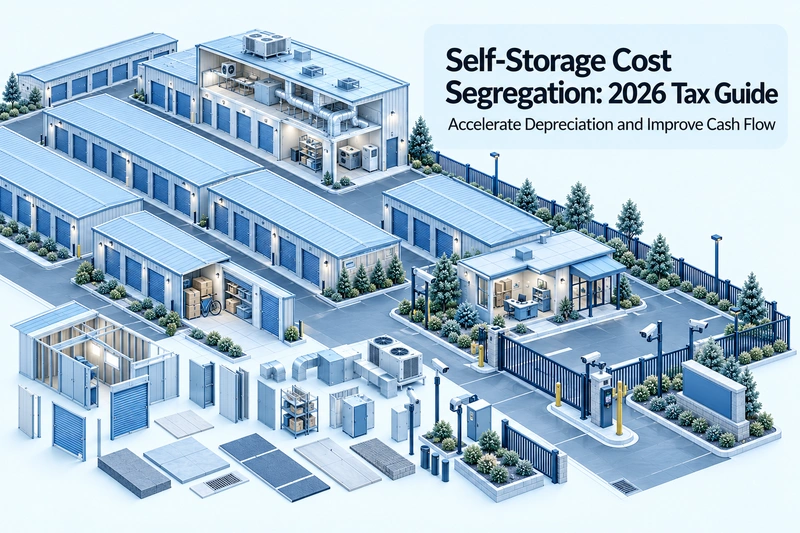
Self-storage facilities are typically built with a mix of fast-depreciating assets, security and access-control systems, supplemental dehumidification equipment, individual unit doors, site paving, fencing, and exterior lighting. Without a proper engineering study, much of that cost defaults to the building's 39-year recovery period under IRC §168, even where individual components clearly have shorter economic lives.
Here's what matters: the IRS allows certain components to be reclassified into shorter MACRS recovery periods, most commonly 5-year tangible personal property and 15-year land improvements (occasionally 7-year property). Instead of recovering those costs over decades, an owner can claim accelerated deductions much earlier.
R.E. Cost Seg provides engineering-based cost segregation services to self-storage facility owners, operators, and developers, identifying and documenting those components. Independent industry benchmarks for self-storage reclassification range roughly from 15% to 40% of depreciable basis, with many projects clustering in the 20%–35% band depending on configuration, climate control, and site improvements.
This article breaks down which self-storage components commonly qualify for accelerated depreciation, how the current bonus-depreciation rules interact with that analysis, and the caveats every investor should weigh before counting on a specific tax outcome.
Why Self-Storage Stands Out for Accelerated Depreciation
Self-storage has grown rapidly as an investment class, driven by relatively low operating intensity and steady demand. From a cost-segregation standpoint, storage facilities tend to be a good fit because they combine:
- Asset diversity: climate-control equipment, access control, lighting, signage, and tenant-use items that are often classifiable as §1245 personal property.
- A high site-improvement ratio: drive lanes, curbs, drainage, fencing, landscaping, and monument signage that typically qualify as 15-year land improvements under Rev. Proc. 87-56 (asset class 00.3).
- Frequent expansions and retrofits: additions and conversions create recurring opportunities for incremental studies.
A storage facility may look like a "simple box," but its tax components rarely are.
What Can Be Reclassified, and What Generally Can't
Under the IRS Cost Segregation Audit Techniques Guide (ATG) and Treas. Reg. §1.48-1(e)(2), the §1245 vs. §1250 analysis is fact-specific. The following groupings reflect how components are typically treated in self-storage studies, not a guarantee for any particular property. For a broader reference on MACRS class lives, see our guide to asset recovery periods.
5-year property (most common short-life bucket)
- Access-control electronics: keypads, card readers, gate operators, surveillance cameras, and motion sensors, where they are not structurally integrated. The gates and fencing themselves are 15-year land improvements; only the electronics belong here.
- Supplemental dehumidification equipment that serves specific tenant areas or §1245 property (note: central HVAC is generally not in this bucket, see below).
- Interior decorative lighting, signage, and electrical components that exclusively serve §1245 property.
- Tenant-use items and movable partitions.
7-year property (less common in self-storage)
- Office furniture, fixtures, and certain equipment without another assigned class life under Rev. Proc. 87-56. In a typical storage facility this is a small bucket.
15-year property (land improvements)
- Asphalt or concrete paving, curbs, drive lanes.
- Retaining walls, drainage systems, utility pads.
- Fencing, gates, exterior site lighting.
- Landscaping and monument signage.
These carry a 15-year recovery period because asset class 00.3 of Rev. Proc. 87-56 assigns them a 20-year class life, not by operation of §168(e)(3)(E), which lists specific categories such as QIP and retail motor fuel outlets.
39-year property (§1250 structural components, not reclassifiable in most cases)
- Core structural framing, walls, foundations, roof systems.
- Central HVAC and primary climate-control systems. Under Treas. Reg. §1.48-1(e)(2), components of a central heating or air-conditioning system, including motors, compressors, pipes, and ducts, are structural components of the building. They are presumptively 39-year property even in climate-controlled facilities. Narrowly tailored, supplemental units that serve specific items of §1245 property can sometimes qualify for shorter lives, but this is a fact-specific carve-out, not a general rule.
- Roll-up and overhead doors on individual storage units. Many practitioners argue these are §1245 personal property; the IRS ATG treats doors as presumptively structural. Outcomes vary by construction details and documentation.
Illustrative example (not a forecast)
For a hypothetical facility with $5 million of depreciable basis (purchase price or construction cost net of land), assuming 30% of that basis reclassifies into short-life property and assuming 100% bonus depreciation is available on that property:
- Reclassified short-life basis: $1.5 million
- First-year deduction (with 100% bonus): up to $1.5 million
- At a 30% combined federal + state marginal rate, that's roughly $450,000 in deferred federal/state tax in year one
Important caveats baked into that math:
- The 30% reclassification assumption is a midpoint of industry ranges, your facility may be higher or lower.
- The 100% bonus assumption is valid only if the property meets the OBBBA acquisition-date test (see next section).
- 30% is below the marginal rate of many high-income real estate investors; federal alone tops out at 37% and most states add 5%–13%. Pick a rate that matches your actual situation.
- The deduction defers tax, it does not eliminate it. See "Recapture and other limits" below.
Bonus Depreciation Under OBBBA, The Critical Date
The One, Big, Beautiful Bill Act (OBBBA, P.L. 119-21, signed July 4, 2025) amended IRC §168(k) to provide a permanent 100% additional first-year depreciation deduction, but only for qualified property both acquired and placed in service after January 19, 2025.
The acquisition-date rule has teeth. Under IRS Notice 2026-11, property is generally treated as acquired on the date the taxpayer entered into a written binding contract for its acquisition. That means:
- A facility under a binding construction or purchase contract signed before January 20, 2025 is generally not eligible for OBBBA's permanent 100% bonus, even if it's placed in service in 2026. It instead remains under the TCJA phase-down: 40% in 2025, 20% in 2026, and 0% in 2027.
- A facility contracted on or after January 20, 2025 and placed in service after that date generally qualifies for permanent 100% bonus depreciation on its 5-, 7-, and 15-year components.
- OBBBA also offers a one-time election to apply 40% bonus (or 60% for certain long-production property) in the first tax year ending after January 19, 2025, useful in some transition-year situations.
In short: do not assume "100% bonus" without checking the binding-contract date.
When to Time a Cost Segregation Study
Timing matters as much as methodology.
- New construction: ideally, schedule the study so it is finalized before filing the return for the year the facility is placed in service.
- At acquisition: purchase basis of an existing facility includes short-life components; a study in the first year of ownership captures those deductions promptly.
- Renovations and expansions: added buildings, conversions to climate control, and security upgrades create new layers of depreciable assets.
- **Look-back / retroactive studies:** if you missed the opportunity in an earlier year, you can generally claim catch-up depreciation in the current year using Form 3115 (Application for Change in Accounting Method) with an IRC §481(a) adjustment under the automatic-consent procedures of Rev. Proc. 2015-13, as automatic change number 7 on the current list in Rev. Proc. 2025-23. A negative §481(a) adjustment is generally deducted in full in the year of change; positive adjustments are generally spread over four years. You do not need to amend prior returns. Two points of precision: the two-return rule decides the path (if the property has appeared on only one filed return, amend that return; Form 3115 applies once two or more returns have been filed on the old method), and the catch-up is computed using the bonus rate in effect for the year the facility was originally placed in service, not today's 100%.
Useful documentation for any study:
- Site plans and architectural drawings
- Contractor invoices, AIA pay applications, and cost summaries
- Equipment lists for climate-control, lighting, and security systems
- Closing statements and purchase-price allocations (for acquisitions)
Recapture, Passive Activity, and Other Limits Investors Should Know
Accelerated depreciation is a powerful timing strategy, but a paper deduction is only worth what you can actually use. Before counting on a specific number:
- **§469 passive activity rules:** Rental losses, including accelerated depreciation on rental real estate, are generally passive and can only offset passive income. The short-term rental exception is essentially never available here: it turns on an average period of customer use of seven days or less, and storage units are rented month to month for months at a time. For a non-operator investor, the realistic routes are real estate professional status under §469(c)(7), passive income from other activities, or a disposition of the entire interest. An owner-operator who holds the facility in a separate entity from the operating business should look at the grouping election under Reg. §1.469-4(d)(1).
- §461(l) excess business loss limit: Even when the loss is nonpassive, non-corporate taxpayers can use net business losses against wages and investment income only up to $256,000 single / $512,000 joint for 2026 (indexed). The excess carries forward as an NOL.
- **Depreciation recapture at sale:** three buckets, and the middle one matters most for storage.
- §1245 personal property: all prior depreciation is recaptured as ordinary income, up to 37% federal.
- 15-year land improvements are §1250 property, not §1245. When 100% bonus is taken on them, §1250 recaptures the excess over straight-line, which is nearly all of it, as ordinary income. Only the straight-line portion is unrecaptured §1250 gain at up to 25%.
- Buildings: unrecaptured §1250 gain at up to 25%.
- Because a storage study is unusually paving-heavy, that second bucket is large, and the exit math is harsher than a simple "25% on the real property" assumption suggests. It makes §1031 planning, or simply holding, more valuable than it first appears.
- §163(j) interest expense limitation: Many real estate businesses elect out as an electing real property trade or business. That election requires the use of ADS (alternative depreciation system) for nonresidential real property, residential rental, and qualified improvement property. Of those, QIP is the only class that would otherwise have been bonus-eligible, so the election costs you bonus on QIP alone; the 5-, 7-, and 15-year components a study identifies keep 100% bonus. For self-storage, which carries little QIP, the election is usually a modest trade-off rather than a deal-breaker.
- **State conformity:** Several states (e.g., California, New York, New Jersey, Pennsylvania) decouple from federal bonus depreciation in whole or part. The state portion of the "combined rate" used in any illustration may not actually materialize in year one.
- At-risk rules under §465 can further limit current-year deductions for some investors.
None of these eliminate the value of cost segregation. They do mean the "first-year savings" headline needs to be modeled against your own facts before you treat it as cash in hand.
Common Missteps in Storage-Facility Depreciation
- Treating paved areas as non-depreciable land. Drive lanes, curbs, and drainage are typically 15-year property, not land.
- Misclassifying central HVAC. Defaulting climate-control HVAC into a 5-year bucket is one of the most common audit-exposure items in self-storage studies.
- Overlooking security and automation systems that may qualify as 5-year personal property when not structurally integrated.
- Relying on rule-of-thumb or residual studies. The IRS Cost Segregation ATG identifies six recognized methodologies and expresses a clear preference for the detailed engineering approach. Rule-of-thumb studies face elevated audit risk.
- Ignoring expansions or remodels. Each addition or major system replacement creates a new layer of depreciable assets.
- Failing to coordinate with a CPA. Bonus depreciation, §163(j), §469, and state conformity interact in ways that can swing the after-tax outcome by a lot.
Turning Accelerated Depreciation Into Real Returns
Cost segregation is fundamentally a timing strategy: it accelerates deductions you would have taken anyway, improving present value and freeing up cash earlier in the hold. In a capital-intensive business like self-storage, that early cash flow can:
- Support debt service and reduce refinancing pressure
- Fund technology upgrades (digital locks, automated monitoring)
- Offset operating cost pressure from insurance or property taxes
- Help finance the next phase of construction without an additional capital raise
It is not a way to permanently eliminate tax, and it is not a fit for every owner, particularly those planning a near-term sale, those without enough passive income to absorb the deduction, or those in states that decouple from the federal bonus.
Bottom Line
When the facts support it, and when the OBBBA acquisition-date rule, §469, §163(j), recapture exposure, and state conformity all line up, an engineering-based cost segregation study on a self-storage facility can produce meaningful, defensible first-year tax savings.
The number depends on the property's components, the investor's tax posture, and the documentation behind the study. Modeled honestly against those constraints, cost segregation is one of the more reliable timing tools available to a storage operator.
If you're evaluating or expanding a storage portfolio, talk to your CPA about whether the numbers work for your specific facts, and ask any cost-seg provider to show you the methodology, the §1245/§1250 analysis, and the OBBBA eligibility check before you sign an engagement. If you'd like our team to model your facility, get a free proposal.