What if your medical office building could generate a six- to seven-figure first-year tax deduction, enough to help fund new equipment and staffing? This isn't theoretical. It's the kind of outcome we've delivered for physician groups completing multi-million-dollar build-outs of multi-specialty facilities, where a properly scoped cost segregation study reclassifies a meaningful share of the building's costs into shorter-life categories. Actual results vary with the property's construction profile, acquisition and placed-in-service dates, the investor's tax posture, and applicable state rules.
Stories like this are common across healthcare real estate. Medical office buildings are loaded with fast-depreciating assets, medical gas lines, lead-shielded walls, specialty HVAC systems, clinical lighting, sterilization plumbing, and diagnostic infrastructure. But unless these components are broken out properly, most taxpayers default to depreciating the entire purchase price (less land) as 39-year nonresidential real property, even when components actually qualify for 5-, 7-, or 15-year recovery under MACRS' asset recovery periods.
Here's what matters: The IRS allows you to reclassify these components into 5-, 7-, or 15-year depreciation categories. Instead of waiting decades to recover your investment, you can claim substantial deductions much earlier in the ownership period.
R.E. Cost Seg specializes in working with healthcare investors, physician groups, and medical facility developers to uncover the value embedded in every property. Our engineering-based studies of medical office buildings typically reclassify 25% to 35% of depreciable basis into shorter-life categories, with equipment-heavy clinical facilities (imaging, surgical, and infusion suites) sometimes reaching 40% or higher.
This article breaks down which medical office building components qualify for accelerated depreciation and what it can mean for your bottom line.
Understanding How Depreciation Shapes Healthcare Investment Returns
Depreciation is one of the most powerful (and misunderstood) tools available to real estate investors. For medical office buildings, it represents both a compliance obligation and a strategic opportunity.
Under standard IRS rules, nonresidential real property is depreciated straight-line over 39 years. That means each year you recover just a small portion of the property's cost through deductions. For a high-cost, clinically outfitted building, that's a long time to wait to reclaim your investment value.
But here's the reality: not every part of a medical office wears out over four decades. Clinical lighting systems, specialized plumbing, flooring, cabinetry, and diagnostic infrastructure all have shorter lifespans, typically five to fifteen years. By identifying and reclassifying these components through cost segregation, investors can accelerate depreciation, taking much larger deductions in the early years of ownership.
This process goes far beyond adjusting numbers on paper. It creates tangible cash flow benefits that can fund growth, cover debt service, or support reinvestment in other healthcare ventures.
Why Medical Office Buildings Are Structurally Different
Unlike traditional commercial offices, medical facilities are designed around clinical function and regulatory compliance. That makes their construction inherently more complex and their tax classification more nuanced.
Medical office buildings often include:
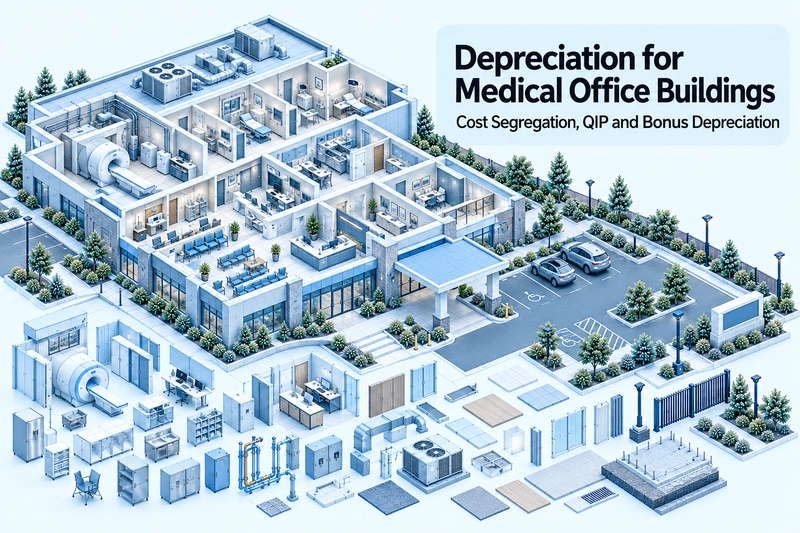
- Procedure and imaging suites with lead shielding, dedicated equipment circuits, and separate equipment pads. These items may qualify as § 1245 property when they serve specific equipment and the drawings and invoices support that function; reinforced structural slabs remain building property.
- Specialized mechanical and electrical systems. HVAC is generally structural unless its sole justification is serving equipment, such as dedicated MRI cooling. Negative-pressure systems and general ventilation that serve occupants generally remain 39-year property.
- Medical gas and specialty plumbing. Medical gas piping may qualify as § 1245 property when it serves specific equipment and is documented accordingly; general plumbing remains structural.
- High-quality finishes and millwork suited to hygienic, high-turnover environments. Removable flooring such as carpet and VCT may qualify as short-life property, while tile and terrazzo generally remain 39-year property.
- Site improvements such as ADA-compliant accessways, covered drop-offs, and enhanced parking, which are generally 15-year land improvements.
Classification turns on each asset's function and supporting documentation, not simply whether it is medically required. A properly executed cost segregation study applies those rules asset by asset and assigns qualifying components to 5-, 7-, or 15-year recovery periods.
The Financial Mechanics of Cost Segregation
Let's consider an example. Suppose you acquire a newly constructed $6 million medical office building housing orthopedic, imaging, and outpatient therapy tenants. First, the land value must be removed because land is not depreciable. Using an illustrative 18% land allocation, the building's depreciable basis would be approximately $4.92 million.
A cost segregation analysis that reclassifies 30% of depreciable basis might reveal that:
- Approximately $1.48 million qualifies as short-life property, such as removable flooring, cabinetry, decorative lighting, dedicated circuits serving specific equipment, equipment supports, and qualifying land improvements.
- Approximately $3.44 million remains in 39-year structural depreciation, including general lighting, building electrical, structural slabs, general HVAC and ventilation, and permanent tile or terrazzo flooring.
The exact land allocation and reclassification percentage must be supported by the property's appraisal, records, and engineering analysis.
Under the One Big Beautiful Bill Act of 2025 (OBBBA), 100% bonus depreciation is permanently reinstated under IRC § 168(k) for qualified property that is both acquired and placed in service after January 19, 2025. Property acquired on or before that date remains subject to the TCJA phase-down, 40% in 2025, 20% in 2026, and 0% thereafter, even if it is not placed in service until later (see IRS Notice 2026-11).
If the property in this example meets both the acquired-after and placed-in-service-after January 19, 2025 tests, you could deduct the entire approximately $1.48 million short-life allocation in the first year. Assuming a 30% combined federal-and-state tax rate for illustration only, that's roughly $444,000 in immediate tax savings. Actual savings depend on the investor's marginal federal and state rates, NIIT exposure, state conformity to federal bonus depreciation, and the rules limiting the current use of losses.
This kind of deduction can transform your after-tax cash flow. It can accelerate your internal rate of return (IRR), improve equity yields, and strengthen borrowing capacity for future acquisitions. For physician groups or healthcare REITs, that capital flexibility is invaluable.
Another major lever for existing medical office buildings is qualified improvement property (QIP). Interior, non-structural improvements made after a building was first placed in service, such as second-generation clinical build-outs and clinic refits, are generally 15-year property and may qualify for bonus depreciation. The original build-out of a newly constructed building is not QIP, and enlargements, elevators, escalators, and work on the building's internal structural framework are excluded.
Even if your property isn't brand new, a look-back or "catch-up" study may unlock missed depreciation. Rev. Proc. 2025-23 lists the accounting-method change under DCN 7, while Rev. Proc. 2015-13 provides the procedural framework. When more than one return has been filed using the impermissible method, the change is generally made on Form 3115, with the catch-up deduction taken as a § 481(a) adjustment in the year of change. If only one return has been filed, the taxpayer generally amends that return instead. For property placed in service before 2025, the bonus rate is determined under the rules applicable to its original placed-in-service year.
Important Caveats Every Healthcare Investor Should Know
The headline numbers above assume best-case mechanics. Before relying on a projected first-year deduction, factor in the following:
- Acquisition-date rule for 100% bonus. OBBBA's permanent 100% bonus applies only to qualified property acquired and placed in service after January 19, 2025. For self-constructed property, the acquisition date generally turns on when physical work of a significant nature began (see IRS Notice 2026-11). Property acquired earlier remains under the TCJA phase-down regardless of when it is placed in service.
- Depreciation recapture at sale. Reclassifying components from § 1250 real property into § 1245 personal property shifts the recapture profile at exit. § 1245 recapture is generally taxed at ordinary rates. Parking and other site improvements generally remain 15-year § 1250 property; when bonus depreciation is claimed, depreciation above straight-line may be recaptured as ordinary income. Unrecaptured gain attributable to the 39-year building is generally taxed at a maximum 25% rate. A 1031 exchange can defer qualifying liability, but it does not eliminate it.
- Passive Activity Loss limits (§ 469), at-risk limits (§ 465), and excess business loss limits (§ 461(l)). A medical office rental is generally passive regardless of ordinary material participation. A loss may be currently usable to the extent the investor has passive income to absorb it or qualifies as a Real Estate Professional and materially participates in the rental, subject to the at-risk and other limitation rules. For 2026, § 461(l) generally limits excess business losses against non-business income to $256,000 for single filers and $512,000 for joint filers under Rev. Proc. 2025-32, with disallowed amounts carried forward under the applicable rules.
- State conformity. Several states, including California, New York, New Jersey, and Pennsylvania, do not conform to federal bonus depreciation. A "combined" federal-plus-state rate assumes a state benefit that may not exist on day one.
- Net Investment Income Tax (3.8%). Where deductions don't offset NIIT, the marginal benefit of acceleration is smaller than a flat marginal-rate calculation suggests.
- Watch the physician self-rental rule. When physicians own a building and lease it to their own practice, Reg. § 1.469-2(f)(6) generally treats net rental income as nonpassive while leaving a cost segregation loss passive. The loss therefore may not offset practice income unless the rental and operating business are validly grouped under Reg. § 1.469-4(d)(1), which generally requires the activities to form an appropriate economic unit and, for certain commonly controlled activities, the same proportionate ownership.
- Coordinate with your CPA. The numbers in this article are illustrative. Final results depend on the property and the investor's full tax posture, and should be modeled jointly with a qualified tax advisor.
Common Pitfalls When Depreciating Medical Office Assets
Despite the clear financial upside, many investors fail to capture these benefits fully, and usually just because of oversight. Here are the most frequent mistakes I've encountered in the healthcare property space:
- Treating clinical build-outs as general office improvements. Imaging and procedure rooms are not comparable to open-plan workspaces. Each should be categorized based on function and expected lifespan.
- Relying on generic templates instead of engineering-based studies. Cookie-cutter depreciation reports miss critical infrastructure components like medical gas systems or shielded electrical.
- Misallocating tenant improvements. The party that pays for and owns the improvement generally depreciates it. Tenant-funded build-outs generally belong to the tenant. Landlord-funded tenant improvements or allowances generally belong to the landlord and may qualify as QIP, § 1245 property, or another applicable class depending on their facts and function.
- Neglecting to separate shared-use and non-clinical areas. Accurate space allocation ensures you don't overstate deductions or leave qualified assets on the table.
- Poor documentation. Without construction drawings, invoices, or specifications, it's difficult to substantiate classifications during an IRS review.
The key is precision. The IRS allows accelerated depreciation, but only for assets that are clearly identified and defensible. That's why medical facilities require specialized analysis, not just tax software.
Setting Up for a Successful Cost Segregation Study
To capture full depreciation benefits, preparation matters as much as execution. If you're planning, building, or renovating a medical office property, these steps can help streamline the process and ensure defensible, optimized results:
- Select an experienced provider. Choose a firm that understands healthcare construction, not just generic commercial real estate.
- Gather detailed records. Architectural drawings, engineering specifications, and contractor invoices are essential.
- Map clinical vs. non-clinical zones. Depreciation lives differ between a waiting room and an MRI suite.
- Include recent renovations. Even partial upgrades or tenant refits may qualify for accelerated treatment.
- Coordinate with your CPA. Integrating cost segregation with your overall tax strategy prevents conflicts and maximizes efficiency.
These steps can often be handled alongside standard financial reporting, meaning there's no need to delay your study until after completion. Early coordination ensures eligible assets aren't lumped into the wrong category.
The Compounding Effect of Accelerated Depreciation
One of the most compelling advantages of accelerated depreciation is its compounding effect. Each property you optimize creates immediate tax relief that can be redeployed into new projects. For multi-property healthcare investors, this creates a self-reinforcing cycle of reinvestment.
Consider a small private equity group with three medical office holdings totaling $18 million in depreciable basis. If each property qualifies under OBBBA (acquired and placed in service after January 19, 2025), a cost segregation study might reclassify roughly 30% (or about $5.4 million) into short-life assets. At a 30% combined rate, that represents approximately $1.6 million of potential federal-and-state tax benefit if the losses are currently deductible after applying the passive activity, at-risk, excess business loss, and state conformity rules. Properties acquired before January 20, 2025 would be subject to the TCJA phase-down rates and produce a smaller first-year benefit.
If those savings are used for additional acquisitions or capital improvements, the cycle continues: more depreciable assets, more deductions, and stronger post-tax cash flow. In effect, cost segregation becomes a tax-efficient growth engine rather than just a one-time deduction.
Turning Depreciation Into an Investment Lever
Healthcare properties are capital-intensive, but they're also full of opportunities for smart tax planning. When handled correctly, accelerated depreciation translates to liquidity that supports growth and stability.
For healthcare investors, aligning precision with purpose is what turns depreciation into a true investment lever. That's where the right expertise makes the difference.
At R.E. Cost Seg, our engineering-driven process identifies and documents every qualifying component, from imaging infrastructure to site improvements, so your medical office building achieves its full tax potential.
For investors aiming to turn depreciation for medical office buildings into measurable, lasting returns, partnering with R.E. Cost Seg, alongside your CPA, is an effective way to make it happen. Get a free proposal to see what a properly scoped study could deliver on your property.