Hotels carry more short-lived personal property than almost any other commercial asset class. A 120-room hotel contains 120 furniture packages, plus lobby, restaurant, and conference furnishings that a warehouse or office building simply does not have. That composition is what makes hotel cost segregation worth doing, and the mechanics are set by asset class, not by negotiation.
This guide covers what actually qualifies as 5-year property in a hotel, how the math works, and, just as important, the four limitations that determine whether you can use the deduction this year.
Key takeaways
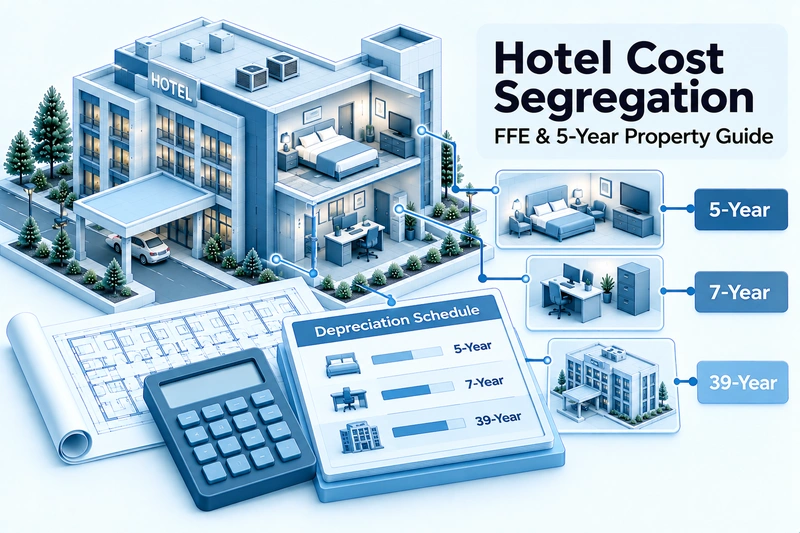
- Hotel guest-room furniture is 5-year property under Asset Class 57.0. Administrative office furniture in the same building is 7-year property under Asset Class 00.11. The distinction turns on whether the furniture is unique to guest rooms and distinguishable from office furniture.
- The building itself remains 39-year nonresidential real property. Cost segregation reallocates basis; it does not change the building's recovery period.
- 100% bonus depreciation is permanent for qualified property acquired and placed in service after January 19, 2025, subject to the written-binding-contract and other eligibility rules. Legacy property tied to a pre-cutoff binding contract generally follows the prior phaseout, including 40% in 2025 and 20% in 2026.
- Hotel operations are generally not a rental activity under the passive activity rules, because the average period of customer use is seven days or less. Real Estate Professional Status is therefore not the relevant test; material participation is.
- FFE recapture is the main exit cost. Section 1245 depreciation on personal property is recaptured as ordinary income, and personal property has not qualified for a 1031 exchange since the 2017 tax act. That recapture cannot be deferred by exchanging.
- Replaced beds, casegoods, televisions, and other separately identified FFE are generally retired as whole assets without a partial disposition election, unless held in a general asset account. A partial disposition election is relevant when only part of a larger asset, such as a roof, HVAC system, or building finish, is retired, and it must generally be made on a timely filed return.
What counts as FFE, and what doesn't
Two different things get called "FFE" in cost segregation conversations, and conflating them causes most of the confusion.
True FFE means movable furniture, fixtures, and equipment: beds, casegoods, seating, lamps, televisions. Five-year property is the broader bucket a study produces: true FFE plus building components that qualify as §1245 property rather than structural components, such as decorative finishes, dedicated wiring, and certain floor coverings.
When a study reports "25% reclassified to 5-year," it means the second, broader category. True movable FFE alone is a much smaller slice of purchase price. This guide uses "5-year property" for the broad bucket and "FFE" only for movable items.
Guest-room assets: the largest concentration
The IRS Cost Segregation Audit Technique Guide contains a hotel and casino matrix that assigns recovery periods asset by asset. Its guest-room furniture entry covers furniture "unique to guest rooms and distinguishable from office furniture. For example, beds, dressers, armoires, and night-tables," and treats it as §1245 property with a 5-year recovery period.
The same matrix is equally useful for what doesn't qualify. Guest-room electrical outlets of general applicability, computerized door locks with their encoders and hardware, and in-room Jacuzzi and whirlpool hook-ups are all treated as §1250 property recovered over 39 years. These are the items that most often surprise owners, and they are the reason a study needs engineering support rather than a walkthrough and a spreadsheet.
Other guest-room items, window treatments, floor coverings installed with strippable adhesive, and decorative lighting that is not the room's primary illumination, are commonly reclassified, but each is a facts-and-circumstances determination. The analysis turns on permanence, function, and the documentation behind it, not on a bright-line removability test.
Public area and restaurant assets
Lobby seating, occasional tables, and decorative casegoods generally qualify for 5-year treatment. Restaurant and bar areas add dining tables, stools, and specialized equipment. Point-of-sale terminals are 5-year property for the same reasoning that makes a retail cash register 5-year property; their dedicated wiring, servers, and software are analyzed separately.
One trap: a reception desk that constitutes office furniture is not automatically 5-year property. Where an item is specifically listed in the office-furniture class, that specificity controls.
Hotel furniture vs. office furniture
This is the core mechanic, and it is worth stating precisely.
Tangible personal property used in a hotel is assigned to an asset class based on the activity in which it is primarily used. Asset Class 57.0 (Distributive Trades and Services) covers assets used in wholesale and retail trade and in personal and professional services, and assets in that class have a recovery period of 5 years for purposes of §168(a) and 9 years for purposes of §168(g).
Administrative office furniture is different. Asset Class 00.11 covers office furniture, fixtures, and equipment that are not structural components, desks, files, safes, and per IRS Publication 946, "The desk has a 10-year class life and a 7-year recovery period for GDS." That class applies across all business activities, so a back-office desk in a hotel is 7-year property even though the bed upstairs is 5-year property.
Mixed-use properties. Casino and gaming assets are assigned to Asset Class 79.0 (Recreation), which carries a 7-year recovery period rather than 5. Again, the test is the activity in which the asset is primarily used, so a hotel-casino complex requires asset-level analysis rather than a single blended assumption.
How much gets reclassified
Reclassification percentages vary with service level and amenity mix. The ranges below reflect the studies our engineers complete; they are internal figures, not published industry benchmarks, and your property's result depends on its actual asset composition.
| Property type | Typical share of depreciable basis moved out of 39-year |
| Limited-service hotel | 25–35% |
| Full-service hotel (restaurant, ballroom, conference) | 35–45% |
Treat these as planning ranges for deciding whether to commission a study, not as a result you should expect before an engineer has seen the property.
Worked example: 120-room limited-service hotel
A 120-room limited-service hotel is acquired for $12 million, with $2 million allocated to land. The $10 million of depreciable basis is 39-year nonresidential real property by default, or about $256,410 per year on a straight-line basis. The first and last years are reduced by the mid-month convention.
A study reclassifies the basis as follows:
- $3.5 million of combined 5-, 7-, and 15-year property eligible for 100% bonus depreciation under the example assumptions.
- $6.5 million remaining in the 39-year building shell.
The accelerated tranches have recovery periods of 20 years or less, so they are bonus-eligible. Year-one depreciation also includes approximately $166,667 on the $6.5 million shell, producing total modeled first-year depreciation of about $3,666,667. Compared with approximately $256,410 without reclassification, the incremental first-year deduction is about $3,410,257. At a 37% top marginal federal rate, that incremental deduction represents approximately $1,261,795 of federal tax deferral if fully usable.
Two conditions sit underneath that number, and neither is optional: the deduction must be currently usable against your income (see below), and the figure is federal only. Many states decouple from bonus depreciation, so your state result will differ and may require a separate calculation.
The four limitations that decide your actual benefit
This is the section most hotel cost segregation content skips. A large deduction and a large refund are not the same thing.
1. Passive activity rules, and why REPS is the wrong test here. Under Treasury Regulation §1.469-1T, an activity involving tangible property "is not a rental activity for a taxable year if for such taxable year, (A) The average period of customer use for such property is seven days or less." A hotel's average stay clears that threshold easily, so hotel operations are generally not a rental activity at all. That means Real Estate Professional Status, which exists to convert rental activities to non-passive, is beside the point. What matters is whether you materially participate in the hotel business. An owner-operator often does; a limited partner in a hotel syndication generally does not, and their share of the loss is suspended until they have passive income or dispose of the interest. For a third-party-managed hotel, the management company’s hours do not count as the owner’s participation, so an owner who is not involved day to day may still have a passive activity despite the seven-day rule.
2. The excess business loss limitation. Even with material participation, Section 461(l) caps how much net business loss a noncorporate taxpayer can use against other income in a year. For 2026, the thresholds are $256,000, or $512,000 for a joint return, under Revenue Procedure 2025-32. On a multimillion-dollar first-year deduction this is frequently the binding constraint, and the excess carries forward.
3. Acquisition requirements for bonus depreciation. Used property qualifies for bonus only if it was not previously used by you and was not acquired from a related party, among other conditions in §168(k). Related-party hotel transfers and sale-leasebacks need to be checked before anyone models a year-one deduction.
4. State conformity. Federal 100% bonus does not flow through automatically at the state level.
Bonus depreciation: the current rule
The One, Big, Beautiful Bill Act (P.L. 119-21, enacted July 4, 2025) made 100% bonus depreciation permanent for qualified property acquired and placed in service after January 19, 2025. Per the IRS, the Act provides a permanent 100% additional first-year depreciation deduction, subject to the acquisition, placed-in-service, and eligibility rules. Property acquired under a qualifying written binding contract before the cutoff generally remains on the legacy phaseout, including 40% when placed in service in 2025 and 20% in 2026. Our summary of the legislation covers the broader changes.
Two mechanical points. Bonus is claimed on Form 4562 with the current-year return, no accounting method change is required for a property placed in service this year. And the Form 4562 instructions note you may instead "elect to take a 40% special depreciation allowance... for this property during first tax year ending after January 19, 2025," which can be useful when a smaller current deduction is worth more than a suspended one.
Some restaurant and kitchen equipment may also qualify for §179 expensing. For tax years beginning in 2026, the maximum §179 deduction is $2,560,000, reduced once §179 property placed in service exceeds $4,090,000. Two cautions: §179 cannot create a loss, because it is limited to business taxable income, and §179(d)(5) restricts the election for non-corporate lessors. If your restaurant FFE is leased to a third-party operator, it may qualify for bonus depreciation but not §179.
Timing: year one, or a look-back
The cleanest time to run a study is the acquisition year, claimed on the original return.
For property already in service, a look-back study is still available. Where an impermissible method has been adopted, an eligible taxpayer may generally request the automatic change listed in Revenue Procedure 2025-23, designated change number 7, using Form 3115 with a Section 481(a) catch-up adjustment. Revenue Procedure 2015-13 supplies the procedural framework for the change. If only one return was filed using the old method, the two-return rule generally calls for an amended return rather than Form 3115. Your CPA should confirm the current procedure and eligibility.
Major renovations are a natural trigger. Franchisor Property Improvement Plans commonly involve substantial FFE replacement, which creates new basis in short-lived classes.
Renovation cycles and partial dispositions
Hotels refresh on a short cycle relative to other commercial property, commonly driven by brand standards rather than by wear. Each cycle creates two separate opportunities, and the second one has a hard deadline.
New FFE placed in service is bonus-eligible. Beds, casegoods, televisions, and other separately identified FFE are generally separate assets, so retiring an entire asset is an ordinary disposition and its remaining basis is recognized without a partial disposition election, unless the asset is held in a general asset account. The partial asset disposition election instead applies when only a portion of a larger asset, such as part of a roof, HVAC system, or finish embedded in the 39-year building, is retired. Under Treasury Regulation §1.168(i)-8, that election is annual and irrevocable and generally must be made on the timely filed return, including extensions, for the year of retirement. As we cover in our guide to partial asset dispositions, missing the deadline generally leaves the disposed portion on its original schedule.
This is also why a $500,000 refresh does not mechanically produce a $500,000 deduction. A refresh typically splits across currently deductible repairs, 5-year FFE, and interior work that is 15-year qualified improvement property. Each is treated differently, and the total depends on that split.
Sequencing renovations across successive years spreads deductions across multiple tax periods, which can help when passive activity or excess business loss limits would otherwise strand a single large deduction.
What a defensible study includes
The Audit Technique Guide was "developed to assist Internal Revenue Service (Service) examiners in the review and examination of cost segregation studies," and it sets out the principal elements of a quality study. A hotel study should track them.
In practice, that means a detailed inventory specifying quantities, locations, and costs by room type, not a lump-sum "guest room FFE" line. It means costs traced through construction documents, invoices, and recognized pricing databases. It means photographic documentation gathered during the site inspection, tied to specific asset classifications. And it means the report citing the ATG sections it relies on, so a reviewer can follow the reasoning.
Ask a prospective provider who bears the cost of defending the classifications if the study is examined. The answer varies more than most owners expect.
Common errors
The most frequent is mixing structural components into the 5-year bucket. Bathroom fixtures permanently affixed to plumbing systems and built-in cabinetry serving a structural purpose stay with the 39-year building.
The second is confusing ordinary retirement of a separately identified FFE asset with a partial disposition of a larger building asset, and then missing the partial disposition election when one is actually required.
The third is modeling a refund before checking whether the loss is usable. For a passive investor, the deduction is real but deferred.
Resale and exit: the trade-off to price in
Cost segregation does not change what your hotel is worth. A buyer prices off comparables and NOI, not your depreciation schedule, and their allocation starts from their own purchase price.
It does change your net proceeds, and hotel owners should understand the three principal recapture buckets. First, 5- and 7-year Section 1245 personal property generally produces ordinary-income recapture to the extent of depreciation allowed or allowable, limited by gain. Second, 15-year land improvements are generally Section 1250 property; when bonus depreciation is claimed, depreciation exceeding straight line can be additional depreciation recaptured as ordinary income. Third, straight-line depreciation on the 39-year building can produce unrecaptured Section 1250 gain subject to a maximum 25% rate for individuals. Accelerating basis can therefore change both the timing and character of gain on exit.
Section 1031 now applies only to qualifying real property, not movable FFE or other personal property. But depreciation classification and the Section 1031 real-property definition are not identical: some 5-year building components identified in a study, such as dedicated wiring or certain finishes, may be Section 1245 property for depreciation yet qualify as real property under Treasury Regulation Section 1.1031(a)-3. Gain on movable FFE is generally recognized in the exchange year. Section 1245 recapture on components that qualify as exchangeable real property is deferred under Section 1245(b)(4) only to the extent the replacement property contains sufficient Section 1245 property. Gain may also be subject to the 3.8% net investment income tax depending on the taxpayer’s circumstances.
Deductions from a newly acquired property can reduce taxable income in the year of a sale, but that is a planning outcome subject to the same passive activity and loss limitation rules, not an automatic offset against recapture.
The practical conclusion: accelerated depreciation is most valuable when the time value of the deferral, at your actual usable tax rate, exceeds the rate differential you accept at exit. A longer hold and a higher current marginal rate both push in favor.
Cash flow, and one thing lenders don't do
Lower current tax liability means more cash available for debt service, distributions, or reinvestment. That is the real benefit, and for an owner-operator with material participation it can be substantial in year one.
One correction worth making, because it circulates widely: a cost segregation study does not improve your debt service coverage ratio as lenders calculate it. Commercial DSCR is underwritten on pre-tax NOI, and tax depreciation is a non-cash item excluded from NOI. The study improves your after-tax cash position, not your covenant math.
Converting from limited to full service
A service-level conversion usually adds restaurant facilities, conference space, and upgraded room amenities. Those new assets are placed in service with their own recovery periods and are bonus-eligible.
FFE that is separately identified and actually removed and retired in the conversion is generally treated as a disposition of the whole asset without a partial disposition election, unless it is held in a general asset account. A timely partial disposition election may be needed when only part of a larger building asset is retired. FFE you keep continues on its existing schedule; nothing resets. "Functionally obsolete" is not a deduction event; retirement is.
Decision checklist
- Depreciable basis above roughly $1 million, so study cost is small relative to the benefit
- Meaningful short-lived asset content; hotels generally qualify on composition alone
- Can you use the deduction this year? For hotels, this usually turns on material participation in the hotel business, or having other passive income to absorb a suspended loss
- Current or near-term tax liability to offset
- Hold period long enough that deferral value exceeds the ordinary-rate recapture you accept at exit
- Related-party or prior-use issues checked against the §168(k) acquisition requirements
- State conformity confirmed for your filing states
If you clear the first four, a study is usually worth pricing. If the third is a no, the deduction still has value; it is just deferred, and that changes the timing case rather than the decision.
Getting started
Gather the closing statement, acquisition contract, and any existing depreciation schedules. Those establish the basis the study works from. Add the rent roll or occupancy detail, franchise agreement, and any pending PIP, and capital expenditure history since acquisition.
Then have your CPA and your cost segregation provider size the usable benefit together, not just the gross deduction. The gap between the two is where most disappointment comes from.
Want to see what your property's numbers look like before you commit? Request a complimentary analysis, and we'll model the reclassification and the year-one usable benefit for your situation.