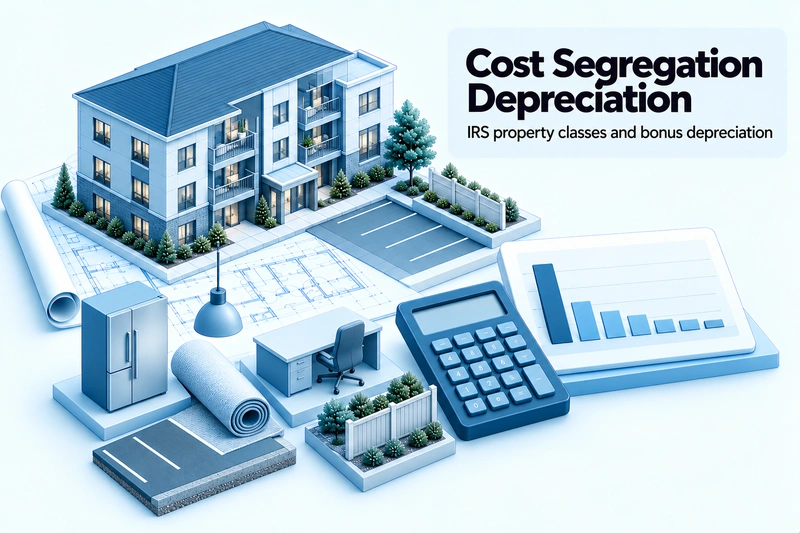
A mobile home park's value sits mostly in things that are not the building: roads, water and sewer laterals, electrical pedestals, drainage, fencing, and lighting. Most of that infrastructure is 15-year land improvement property rather than 27.5-year building property, which is why parks are one of the stronger asset classes for cost segregation.
This guide covers which park components qualify for shorter recovery periods, what the current bonus depreciation rules actually require, where park-owned homes get complicated, and what accelerating depreciation costs you when you sell.
What the depreciation rules actually say
Under MACRS, qualifying residential rental buildings generally depreciate over 27.5 years, while nonresidential buildings generally use 39 years. Land improvements generally depreciate over 15 years. Qualifying personal property depreciates over 5 or 7 years depending on its asset class. Land itself is not depreciable.
The 80% residential-rental-income test under Section 168(e)(2)(A) applies building by building, not to the park’s combined income. A building generally qualifies for the 27.5-year class when at least 80% of its gross rental income for the year comes from dwelling units, as explained in IRS Publication 527. Lot rent from tenant-owned homes is land rent, not rent from dwelling units owned by the park. Park offices, clubhouses, and maintenance buildings therefore generally use 39 years; qualifying rented dwelling units, such as park-owned homes classified as residential rental property, generally use 27.5 years. Classify each building separately before modeling depreciation.
Bonus depreciation sits on top of these recovery periods. It applies to MACRS property with a recovery period of 20 years or less, which covers the 5-, 7-, and 15-year assets a study identifies. It does not apply to the 27.5-year or 39-year building shell.
The current bonus depreciation rule, stated precisely
The One Big Beautiful Bill Act was signed into law on July 4, 2025 as Public Law 119-21. It made 100% bonus depreciation permanent, with no scheduled phase-down.
The effective date is separate from the enactment date, and this is where investors get caught. Per IRS Topic No. 704, "For qualified property acquired and placed in service after January 19, 2025, the special depreciation allowance is 100%." Both tests must be met.
Three conditions determine whether your park qualifies:
- The acquisition test. The property must be acquired after January 19, 2025. Treasury and the IRS addressed the acquisition and binding-contract rules in Notice 2026-11, interim guidance issued ahead of proposed regulations under § 168(k).
- A binding written contract signed on or before January 19, 2025 can disqualify you, even if you closed and placed the property in service months later. Ordinary qualifying pre-cutoff property generally receives 60% if placed in service in 2024, 40% in 2025, 20% in 2026, and 0% after 2026. Contract enforceability, cancellation periods, and contingencies must be reviewed; the signing date alone is not automatically controlling.
- You can elect a lower rate. The Form 4562 instructions confirm you may elect a 40% special depreciation allowance instead of 100% for the first tax year ending after January 19, 2025. That election is sometimes the better answer when a large year-one loss would be suspended or capped anyway.
If you bought your park before 2025, none of this is retroactive. The rate that applies is the rate in effect for your acquisition and placed-in-service dates.
Which park components move to shorter lives
Asset classification follows the IRS Cost Segregation Audit Techniques Guide, which is the examination playbook agents use. A study that tracks the ATG's classification logic and documentation standards is the one that holds up.
Typically 15-year land improvements:
- Paved roads, parking areas, and speed bumps
- Water and sewer laterals serving individual lots
- Electrical pedestals and underground distribution
- Storm drainage and stormwater management systems
- Perimeter fencing and entry gates
- Site lighting, signage, and pylons
- Playground equipment and pavilions
Typically 5- or 7-year personal property:
- Laundry facility equipment
- Office furniture, computers, and office machinery
- Maintenance tools and equipment
- Security camera and monitoring systems
Building property, classified separately for each building:
- Community centers, offices, maintenance buildings, and permanent storage structures generally use 39 years.
- Park-owned homes rented as dwelling units generally use 27.5 years when classified as residential rental property.
- Manager residences require review of their actual use and applicable residential-rental rules; park-wide lot income does not determine their recovery period.
Two cautions. Site utilities are not automatically land improvements, the test is whether the asset relates to the operation or maintenance of a building, and a utility line feeding the community center is analyzed differently from one feeding a tenant pad. And exterior signage and pole-mounted lighting generally land in the 15-year bucket, not the 5-year bucket, despite how movable they look.
Allocation between land and improvements is the other lever. See our explanation of land value in cost segregation for how that split is supported.
What makes mobile home parks different from apartment buildings?
A larger share of a park's depreciable basis sits in site infrastructure rather than in a vertical building. In an apartment complex, most of the cost is the structure itself, which stays on a 27.5-year schedule. In a park, roads, utilities, pads, and site electrical can dominate. The actual split varies by park age, density, utility configuration, and how the purchase price allocates to land, so treat any percentage you see quoted online, including ours, as an illustration rather than a benchmark until an engineer has looked at your property.
A worked example, with every assumption stated
Assume a $2,000,000 park, 20% allocated to nondepreciable land, leaving $1,600,000 of depreciable basis. Assume a 35% combined marginal rate, state conformity for purposes of this illustration, full current deduction usability, and an 8% discount rate. Also assume the $500,000 remaining after component classification consists of qualifying 27.5-year residential rental dwellings, not park offices or maintenance buildings. These are illustrative assumptions, not a projection for your park.
Simplified unsegregated comparison: assume the entire $1,600,000 had been recorded in a 27.5-year account. This is an illustration of an unsegregated schedule, not the correct classification of all park infrastructure or nonresidential buildings:
- Annual deduction: $1,600,000 ÷ 27.5 = $58,182
- 10-year deductions: $581,820
- Tax benefit over 10 years: $203,637 nominal
- Present value of that benefit, discounted at 8%: roughly $136,600
With a study, assume the engineer reclassifies the basis as $900,000 to 15-year land improvements, $200,000 to 5- and 7-year personal property, and $500,000 to the building:
- Bonus-eligible basis: $1,100,000
- Year-one bonus deduction if 100% bonus applies: $1,100,000
- Tax effect of that bonus deduction at 35%: $385,000, if fully usable
- The remaining $500,000 continues over 27.5 years under the dwelling-unit assumption above, adding regular depreciation
Cost segregation does not create additional depreciation. Compare both schedules over the same full-life horizon rather than comparing ten years of deductions with one year of bonus. Using a simplified 27.5-year annuity model, an 8% discount rate, a 35% tax rate, and year-end cash flows, the present value of tax benefits is about $224,000 under the unsegregated comparison and $426,000 with the assumed study allocation—an incremental timing benefit of about $203,000 before study fees and exit taxes. The model discounts the bonus tax benefit to the end of Year 1 and includes regular depreciation on the remaining $500,000; it ignores MACRS first- and last-year conventions. Actual nonresidential buildings require a separate 39-year schedule.
The property must satisfy bonus eligibility, the deductions must be usable, and state treatment must be modeled separately. A sale and recapture can materially change the result. Run your own numbers with the cost segregation calculator and your tax adviser.
Whether you can actually use the deduction
This is the step that determines whether a park owner sees $385,000 or $0 this year, and it is the most common reason a study disappoints.
Rental real estate is passive by default. Passive losses offset passive income; excess losses are suspended and carried forward until you have passive income or dispose of the activity in a fully taxable transaction. Investors who meet the material participation and hours tests for real estate professional status can use rental losses against non-passive income, but that status has to be earned and documented, not assumed.
Even if you clear the passive hurdle, the excess business loss limitation under Section 461(l) can cap the net business loss a noncorporate taxpayer deducts against nonbusiness income, after basis, at-risk, and passive-activity limits. For 2026, the thresholds are $256,000, or $512,000 for a joint return, under Revenue Procedure 2025-32. Disallowed amounts generally become net operating loss carryforwards. A $1.1 million deduction warrants modeling the taxpayer’s total business income and losses rather than assuming the full amount is currently usable.
State conformity is the third filter. Many states decouple from federal bonus depreciation and require an add-back with a separate state depreciation schedule, so your state benefit may look nothing like your federal benefit.
None of these are reasons to skip a study. They are reasons to model the outcome before you buy one, and reasons the 40% election exists.
Park-owned homes: a facts-and-circumstances question
When the park owns the manufactured homes, investors often assume the homes are 5-year personal property. That is not the default. Publication 527 places a mobile home that functions as a rental dwelling in the 27.5-year residential rental class. Whether a specific unit can instead be treated as personal property depends on a permanency analysis: how it is mounted, whether it is on a permanent foundation, how it is connected to utilities, whether it retains its wheels and axles, and whether it can be moved without material damage.
Where the facts support personal property treatment, purchase invoices, delivery receipts, installation records, and photographs are what carry the position on examination. Where they do not, 27.5 years is the correct and defensible answer.
Illustratively, 20 park-owned homes at $30,000 each represent $600,000 of basis. If the permanency analysis supports 5-year treatment and the homes were acquired after January 19, 2025, that basis is bonus-eligible in year one. If either condition fails, it is not. Get this position reviewed by your CPA rather than inferring it from the sales price.
Furniture and appliances inside park-owned units are separately analyzed and commonly fall in the 5-year class.
Look-back studies on a park you already own
Can I run a study on a park I've owned for years?
Usually yes, without amending prior returns. You file Form 3115 to change your method of accounting for depreciation and take a § 481(a) catch-up adjustment for the difference in the year of change. Most depreciation method changes of this type are eligible for automatic IRS consent, so no advance ruling is required; the Form 3115 instructions set out the filing procedure and the revenue procedures that govern automatic changes.
One eligibility condition the marketing usually omits: a method change generally requires that the impermissible method has been used for two or more consecutive tax years. If only one return was filed using the old method, an amended return is generally the appropriate correction rather than Form 3115, subject to the taxpayer’s applicable filing procedures. For a park placed in service this year before any depreciation return is filed, implement the study on the original return. R.E. Cost Seg offers Form 3115 preparation as a $600 add-on.
The bonus rate that applies to a look-back is the rate in effect when the property was acquired and placed in service, not today's 100%.
What acceleration costs you at exit
Front-loading depreciation lowers your basis, which raises gain on sale. Two different recapture regimes apply, and the split matters more in a park than in most property types.
Section 1245 equipment generally produces ordinary-income recapture to the extent of depreciation allowed or allowable, limited by gain. Roads, fencing, and water and sewer laterals are generally Section 1250 property, but that does not limit all their depreciation-related gain to a 25% rate. Bonus depreciation exceeding straight-line depreciation can be additional depreciation recaptured as ordinary income under Section 1250. Only the remaining qualifying depreciation-related gain, including eligible straight-line depreciation on buildings and improvements, may be unrecaptured Section 1250 gain taxed at a maximum 25% rate for individuals under IRS Topic No. 409—a cap, not a flat rate.
Asset Class 00.3 can include both Section 1245 and Section 1250 property, so track classifications asset by asset. For typical park infrastructure, the important ordinary-income exposure is often bonus depreciation on Section 1250 improvements, not an assumption that all accelerated infrastructure is Section 1245 property. Our guide to depreciation recapture walks through the calculation.
A 1031 exchange defers gain on the real property, but it is not a clean escape:
- Since the Tax Cuts and Jobs Act, § 1031 applies only to exchanges of real property, not personal or intangible property. Park-owned homes treated as personal property and 5-year equipment are outside the exchange entirely.
- Depreciation classification is not the same as exchange status. Some components treated as Section 1245 property in a study can qualify as real property under Treasury Regulation Section 1.1031(a)-3. For exchangeable Section 1245 real property, Section 1245(b)(4) can trigger recapture to the extent the replacement property does not contain sufficient Section 1245 property, even when no boot is received. Model that exposure separately from boot.
- Deferral ends at the first taxable disposition. It is a deferral, not an exemption.
If your hold period is short, model the exit before you accelerate. There are parks where the answer is to skip the study or elect a lower bonus rate.
Other provisions worth checking
- Section 179 expensing. Qualifying park-owned equipment may be eligible when acquired for active trade-or-business use, subject to the annual dollar limits and business-income ceiling. Current IRS Publication 946 includes certain property used to furnish lodging among eligible property, so appliances and furniture in park-owned homes are not categorically excluded solely because of lodging use. However, Section 179(d)(5) restricts noncorporate lessors, and not every rental activity or leased asset qualifies. Have the tax adviser test business use, lessor eligibility, and asset-specific requirements before electing.
- § 179D. The energy efficient commercial buildings deduction is available for qualifying energy-saving property. The statutory range is $0.50 to $1.00 per square foot, rising to $2.50 to $5.00 per square foot where prevailing wage and apprenticeship requirements are met, with the dollar values indexed annually for inflation, confirm the current year's adjusted figures before quoting a number. Two caveats: a § 179D deduction reduces the property's depreciable basis, so it does not simply stack on a cost segregation result, and solar generation is generally handled under the energy investment credit rather than § 179D. Eligibility is also narrow for single-story park buildings. OBBBA terminates Section 179D for property whose construction begins after June 30, 2026. New projects beginning after that cutoff are therefore ineligible; projects begun by the cutoff still require review of all other requirements. Confirm and document the construction-start date before relying on the deduction.
- Opportunity Zones. OBBBA made the Opportunity Zone program permanent, with changes phasing in from 2026. The 10-year hold requirement for the permanent gain exclusion still applies.
Getting a study done
Documents to gather:
- Purchase agreement and closing statement
- Site plans, surveys, and plat maps
- Utility infrastructure diagrams
- Capital improvement receipts and invoices
- Tenant roll and lot inventory
- Prior tax returns and depreciation schedules
Timelines and pricing. A Rapid Report starts at $950 and is typically delivered in 5–10 business days after intake, with no site visit, though its eligibility limits (residential, up to four units, under 3,500 sq ft per unit, depreciable basis up to $1.2M) mean most parks will not qualify. A Fully Engineered Study starts at $2,320 for residential and $2,730+ for commercial properties and typically takes 15–20 business days after documents and the inspection are complete. A five-business-day rush option may be available. Final pricing depends on square footage, property type, complexity, and construction or renovation costs. Our breakdown of what drives study pricing has more detail.
Whether an inspection is physical or virtual depends on the property; we cover the IRS's actual expectations in our piece on site visits and cost segregation studies.
What a defensible study includes: detailed engineering analysis, photo documentation, a component-by-component breakdown tied back to total cost, an explanation of how indirect costs were allocated, a fixed asset schedule your CPA can import, and written audit support. Those elements track the ATG's description of a quality study.
Engage a study preparer before closing where you can. Pre-acquisition analysis informs how the purchase price is allocated, and your CPA needs the final report in hand before the filing deadline.
Key takeaways
- Most of a mobile home park's depreciable basis sits in 15-year land improvements: roads, utilities, pads, site electrical rather than in 27.5-year building property.
- 100% bonus depreciation is permanent under P.L. 119-21, enacted July 4, 2025, but applies only to qualified property both acquired and placed in service after January 19, 2025.
- A qualifying pre-cutoff acquisition can leave ordinary eligible assets on the legacy schedule: 60% when placed in service in 2024, 40% in 2025, 20% in 2026, and 0% after 2026. Review both dates and the binding-contract facts.
- Apply the 80% dwelling-unit rental-income test building by building. Lot rent from tenant-owned homes is land rent; offices, clubhouses, and maintenance buildings generally use 39 years, while qualifying park-owned rental dwellings generally use 27.5 years.
- Park-owned homes are not automatically 5-year property. Publication 527 treats a mobile home functioning as a rental dwelling as 27.5-year property absent a supportable permanency analysis.
- Passive activity rules and the § 461(l) excess business loss cap determine whether a large year-one deduction is usable this year or suspended.
- Land improvements can be Section 1245 or Section 1250 property. Bonus exceeding straight-line depreciation on typical Section 1250 roads, fencing, and laterals can produce ordinary-income recapture; the 25% cap applies only to qualifying unrecaptured Section 1250 gain.
- After two or more returns using the old depreciation method, an eligible look-back study generally uses Form 3115 and a Section 481(a) adjustment. With only one return filed, an amended return is generally the correction route, subject to applicable taxpayer-specific procedures.
Next step
Before you commission anything, work out three numbers for your park: your acquisition date relative to January 19, 2025, whether you can use a passive loss this year, and your expected hold period. Those three answers tell you whether a study pays, whether to elect a lower bonus rate, or whether to wait. Run the estimate yourself with the calculator above, then take the output to your CPA.