In one recent R.E. Cost Seg engagement, a mid-sized sponsor closing on an approximately $7M, ~70-unit residential rental property reclassified roughly $2.1M of components through a cost segregation study. This was a top-of-range outcome and generated a first-year deduction large enough to offset a meaningful portion of taxable income for partners who could use it.
The cash-tax impact for any individual investor depended on their marginal rate, their ability to use the loss under the passive activity rules (IRC §469), and the expected depreciation recapture at sale. Figures are case-specific and not a guarantee of similar results.
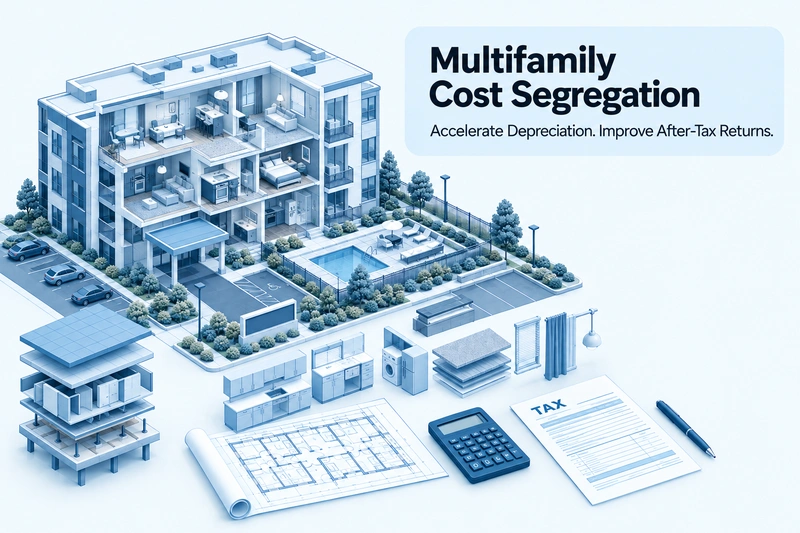
Apartment properties contain many fast-depreciating components, such as appliances, flooring, cabinetry, parking lots, site lighting, landscaping, but absent a cost segregation study, taxpayers typically default to depreciating the entire building over 27.5 years, leaving shorter-life components un-separated.
The IRS, through MACRS, allows those components to be classified into 5-, 7-, or 15-year recovery periods when the allocation is properly supported by an engineering-based study (see IRS Publication 5653, Cost Segregation Audit Techniques Guide, Feb. 2025).
The One Big Beautiful Bill Act (OBBBA), signed into law on July 4, 2025, as P.L. 119-21, permanently restored 100% bonus depreciation under IRC §168(k) for qualified property both acquired and placed in service after January 19, 2025. Because the rate is now permanent rather than phasing down, the planning advantage is predictability, not urgency. There is no scheduled rate decline to race against.
Binding-contract carve-out: Property acquired under a written binding contract entered into before January 20, 2025, is treated as acquired on the contract date and is not eligible for the 100% rate, even if placed in service later. Such property remains on the prior phase-down based on its placed-in-service year: 40% if placed in service in 2025 and 20% if placed in service in 2026. Sponsors closing on pre-January 20, 2025 contracts should confirm this with their CPA before modeling bonus depreciation.
R.E. Cost Seg works with multifamily sponsors, syndicators, and operators to identify reclassifiable components. Across our multifamily portfolio, engineering-based studies have historically moved roughly 20%–35% of an apartment property's depreciable basis (purchase price net of land) into shorter-life categories. Actual results vary materially with vintage, finish level, amenity load, and renovation history, and are not guaranteed for any specific property.
This article covers which components qualify, how to model a realistic example honestly, the recapture and loss-limitation rules that govern when those deductions translate into cash, and what to prepare before commissioning a study.
What Cost Segregation Actually Covers in a Multifamily Asset
Even a standard, newly built, acquired, or renovated apartment property contains dozens of components that qualify for shorter MACRS recovery periods. Under MACRS GDS (IRS Pub. 946):
- Structural elements (walls, foundations, roofs, plumbing, and electrical systems integral to the building) are residential rental real property, depreciated over 27.5 years straight-line.
- Land improvements (parking lots, sidewalks, signage, fencing, exterior landscaping) are typically 15-year property, depreciated using 150% declining balance.
- §1245 personal property (appliances, carpet and other floor coverings, millwork, cabinetry, decorative lighting, window treatments) is generally 5- or 7-year property.
Cost segregation is the engineering-and-tax process of separating those components from the building shell so that 5-, 7-, and 15-year assets are not stranded inside the 27.5-year class.
A Realistic, Honest Worked Example
The numbers below are illustrative and sit near the top of our historical range. They are not a quote, a guarantee, or representative of every deal.
Assume a residential rental property with an $8.2M depreciable basis (purchase price net of land). A study allocates:
- 5- and 7-year property: $1.9M (appliances, carpet, interior finishes)
- 15-year property: $0.9M (parking, exterior lighting, fencing, signage)
- 27.5-year structural property: $5.4M
That totals $2.8M of short-life (≤20-year class) property, about 34% of the depreciable basis, a top-of-range outcome.
If the property is both acquired and placed in service after January 19, 2025 (and is not under a pre-Jan 20, 2025, binding contract), the entire $2.8M can be deducted in year one under IRC §168(k), subject to all of the following:
- Qualifying acquisition. New property qualifies because its original use begins with the taxpayer. Used property, most multifamily acquisitions, qualifies under §168(k)(2)(E)(ii) only if the taxpayer never previously held a depreciable interest in it and did not acquire it from a related party, a member of the same controlled group, or in a carryover-basis transaction. Property contributed by a partner to a partnership generally takes carryover basis under §723 and does not qualify for bonus depreciation. By contrast, a §743(b) basis adjustment from buying an interest from an unrelated partner can qualify. A lease-to-own or seller-financed purchase from an unrelated party can also qualify if the other requirements are met.
- Passive activity loss limits (§469). Most syndication LPs are passive investors. They generally cannot deduct passive losses against ordinary W-2 or active business income unless they qualify as a real estate professional under §469(c)(7), meet the short-term-rental material-participation rules, or have other passive income to offset.
- Excess business loss limit (§461(l)). Non-corporate taxpayers face an annual cap on aggregate business losses. For 2026, the limits are $256,000 for single filers and $512,000 for joint filers under Rev. Proc. 2025-32. OBBBA made §461(l) permanent and reset the inflation base, which lowered the 2026 thresholds from the 2025 amounts. Losses above the cap carry forward as NOLs.
- Depreciation recapture at sale. The treatment generally falls into three buckets: §1245 recapture on 5- and 7-year personal property is taxed at ordinary rates (up to 37%); for 15-year land improvements, depreciation in excess of straight line, including bonus depreciation, can be recaptured as ordinary income; and unrecaptured §1250 gain on the 27.5-year building shell is taxed at up to 25%. Recapture can claw back a meaningful portion of the year-one benefit when the property is sold.
Hypothetical math: A $2.8M deduction reduces taxable income by $2.8M. At an assumed 30% combined federal-and-state marginal rate, that deduction is worth about $840,000 of tax reduction in year one, before §469/§461(l) limitations and before future recapture. It is not the same as $840,000 of permanent, realized cash savings. Investors should model the after-tax IRR net of expected recapture, not the gross deduction headline.
Frequently Missed Assets in Multifamily Properties
The most common deficiency in multifamily studies is underutilization, leaving qualifying components inside the 27.5-year class because no one flagged them. Items that an engineering-led study should evaluate include:
- In-unit appliances (refrigerators, dishwashers, stoves, microwaves)
- Carpet, vinyl, and tile flooring (note: tile mortared to a structural slab can be a closer call)
- Kitchen and bath cabinetry and countertops
- Window coverings
- Decorative and pole-mounted site lighting
- Retaining walls and hardscaping
- Clubhouse and leasing-office finishes
- Pool equipment, fencing, and decking
Each is a candidate for shorter recovery, but the correct classification depends on facts the engineer documents on site and in the construction records, not on a template.
Common Mistakes With Accelerated Depreciation
- Defaulting to a single 27.5-year schedule without analysis, when an engineering-based study could properly reclassify components.
- Skipping land-improvement analysis. Parking lots, sidewalks, signage, and exterior landscaping are sometimes misclassified as non-depreciable land.
- Using software-only or rule-of-thumb studies. The IRS Cost Segregation ATG (Pub. 5653) explicitly cautions examiners about rule-of-thumb approaches and ranks the detailed engineering approach from actual cost records as the most reliable.
- Ignoring partial asset disposition. Under Treas. Reg. §1.168(i)-8(d)(2), when units are renovated, the adjusted basis of the disposed components (e.g., old appliances or carpet) can be written off, but the election is annual and must be made on a timely-filed return for the year of disposition.
- Failing to coordinate with broader tax planning. Cost segregation interacts with §469, §461(l), §163(j) interest limits, §199A, and any §1031 exchange strategy. It should not be evaluated in isolation.
Before You Commission a Study: What to Line Up
- Select an engineering-led provider. Multifamily reclassification depends on physical asset detail. The IRS prefers the detailed engineering approach over template-only methods.
- Document recent improvements. Renovation work, upgrades, and capital replacements may be eligible, and may also create partial-disposition opportunities for the components they replaced.
- Organize your records. Closing statements, appraisals with land allocations, blueprints, site plans, contractor invoices, and unit finish schedules all help an engineer assign defensible asset lives.
- Clarify unit mix and use. Studios vs. two-bedrooms, standard vs. premium finishes, amenities vs. common space, these drive component allocations.
- Align with your CPA early. Confirm how the study will flow through the partnership return, how §469/§461(l) will affect each partner, and whether a current-year study or a look-back study (see below) is more appropriate.
Current-Year vs. Look-Back Studies: Form 4562 vs. Form 3115
A frequent source of confusion:
- Current-year study (property placed in service in the current tax year). Bonus depreciation and accelerated MACRS are claimed directly on Form 4562, Depreciation and Amortization, with the tax return. Form 3115 is not required.
- Look-back study (property placed in service in a prior year, where depreciation was understated). If only one return has been filed using the incorrect method, the taxpayer generally corrects it by amending that return. Once two or more returns have been filed using the method, the taxpayer generally changes its method of accounting under Rev. Proc. 2015-13 and the current automatic-change list in Rev. Proc. 2025-23 (designated change number 7) by filing **Form 3115, Application for Change in Accounting Method**, and takes a one-time IRC §481(a) catch-up adjustment in the year of change, without amending prior returns.
Which path applies depends on the placed-in-service dates, the taxpayer's tax history, and CPA coordination.
Why This Strategy Can Pay Off Across a Multifamily Portfolio
Cost segregation is a scalable tool for improving after-tax yield when (a) the partners can actually use the resulting losses under §469 and §461(l), and (b) the deal model honestly accounts for depreciation recapture at exit. Where both conditions are met, the impact compounds across a portfolio of acquisitions and repositions in the same tax year.
Because OBBBA made 100% bonus permanent, sponsors can plan multi-year acquisition pipelines without phase-down risk, provided each property clears the post-Jan 19, 2025, acquired-and-placed-in-service test (and is not stuck on a pre-Jan 20, 2025, binding contract).
R.E. Cost Seg brings the engineering accuracy and tax-rule alignment needed to make these studies defensible under the February 2025 IRS Cost Segregation ATG. Unit by unit, building by building, asset by asset, when the rules permit.