Key takeaways
- The partial asset disposition (PAD) election lets you deduct the remaining adjusted depreciable basis of building components you remove during a renovation, instead of depreciating assets that no longer exist.
- You must make the election on a timely filed original return, including extensions, for the year of the disposal. There is no late election and no amended-return fix.
- The loss is an ordinary loss, generally reported on Form 4797, Part II, line 10, rather than a §1231 loss. Once you elect, removal costs generally need not be capitalized as part of the replacement improvement, though other capitalization rules must still be checked.
- §280B blocks the deduction when you demolish an entire structure. Those costs and the remaining basis go to the land.
- A $300,000 disposed basis is worth up to $111,000 in federal tax at a 37% marginal rate, but only if passive activity and excess business loss rules let you use the deduction this year.
What a partial asset disposition is
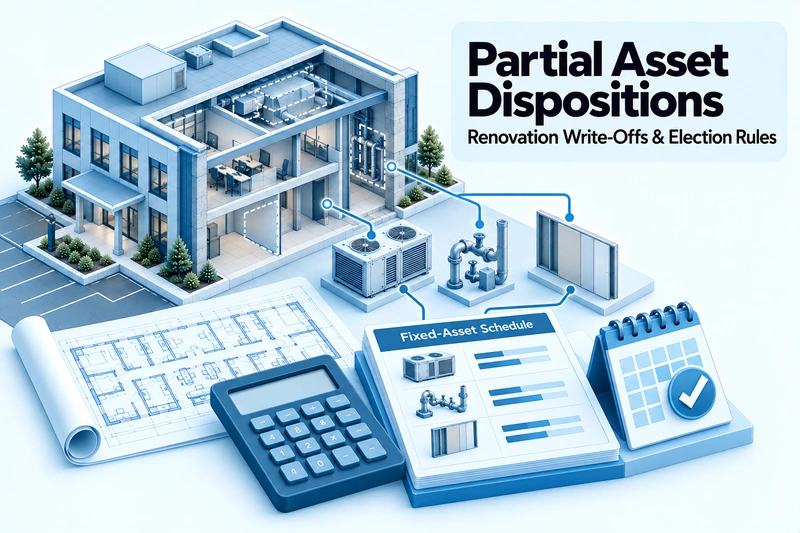
A partial asset disposition lets you deduct the remaining adjusted depreciable basis of building components you remove or replace. Treasury Regulation §1.168(i)-8(d) treats that removal as a disposition. You write the basis off now instead of depreciating it across the building's remaining 27.5-year or 39-year schedule.
The IRS confirms the treatment in Publication 544: "Loss from abandonment of a portion of a MACRS asset is deductible if you make a partial disposition election."
The rules have applied to tax years beginning on or after 1 January 2014, under T.D. 9689.
The election is usually optional. Section 1.168(i)-8(d)(1) makes partial disposition treatment mandatory in specific cases, including a sale of a portion of an asset, a casualty loss, and a like-kind exchange.
§280B: the limit most articles skip. *IRC §280B denies any deduction for demolition costs or losses when you demolish a structure, and charges both to the capital account for the land. The IRS practice unit Examining a Taxpayer Electing a Partial Disposition of a Building lists this first: "A partial disposition cannot be recognized if: there is a demolition of a building under IRC 280B." PAD applies to components removed from a building that stays in service. It does not apply to a teardown.*
Does §280B mean I lose the benefit if I gut a building to the studs?
Not necessarily. §280B applies to demolition of the structure itself, not every extensive interior renovation. Revenue Procedure 95-27 provides a retention safe harbor: a building is not treated as demolished if at least 75% of its existing external walls are retained in place as external walls and at least 75% of its existing internal structural framework is retained in place. Document both retention tests with plans, photographs, and contractor records. Projects outside that safe harbor require a facts-and-circumstances analysis; continued use alone does not establish that §280B is inapplicable. Confirm the treatment with your tax adviser and support the land allocation if the project includes a teardown.
What the election is worth
Take a $500,000 interior renovation of a 15-year-old office building. The work removes interior walls, the electrical distribution, the plumbing, and the HVAC system. Assume the removed components carry $300,000 of adjusted depreciable basis with 24 years of recovery remaining.
Without the election you depreciate the removed components and their replacements at the same time. The $300,000 does not disappear. It just arrives in $12,500 slices over 24 years.
One caveat on the replacement side. Much of a nonresidential interior renovation is Qualified Improvement Property, which carries a 15-year recovery period and qualifies for bonus depreciation. Treating the full $500,000 as 39-year property overstates the gap.
How and when to make the election
This is where most claims fail. The regulation requires you to make the election "by the due date, including extensions, of the original Federal tax return for the taxable year in which the portion of an asset is disposed of by the taxpayer." You make it by reporting the loss on that return, generally on Form 4797. You do not make it on Form 3115.
Can I make a PAD election for renovations completed in prior years?
Generally no. The automatic accounting method change for late partial disposition elections, DCN 196, is marked "Obsolete" in the Instructions for Form 3115, and it only ever covered tax years beginning before 1 January 2015. Two narrow routes remain. Section 1.168(i)-8(d)(2)(iii) permits a late election when the IRS disallows a repair deduction and capitalizes the cost. Otherwise you need discretionary relief under §301.9100-3, which requires a private letter ruling. The IRS granted exactly that in PLR 201747003, where the "Taxpayer was unaware that the partial disposition election had to be made on a timely filed federal tax return."
Form 3115 still matters for cost segregation catch-up depreciation on a property you already own. That is a genuine accounting method change. Use the current automatic change list in Rev. Proc. 2025-23, which superseded Rev. Proc. 2024-23 in part for Forms 3115 filed on or after 9 June 2025.
The practical consequence: build the election into your year-end close. Miss the deadline and the basis stays on its original schedule.
Establishing the basis of removed components
You need a defensible number for the disposed portion. Section 1.168(i)-8(f)(2) sets out the acceptable approaches.
- Cost segregation study allocation. The cleanest option when a study already values the components.
- Discounting the replacement cost. Take the cost of the replacement component and discount it back to the placed-in-service year of the original, using the Producer Price Index. This is not a current-value appraisal adjusted for wear.
- Pro rata allocation. Allocate original construction or acquisition cost across components using square footage or another reasonable metric.
Apply one method consistently and document why you chose it. You also need a depreciable interest in the component. If you bought the building, allocate basis from the purchase price rather than assuming a prior owner's cost.
How do I determine the basis of a 20-year-old HVAC system?
Start with the original construction documents, the closing statement, or the fixed asset ledger. If none survive, use a documented allocation method and published construction cost data such as RS Means or Marshall & Swift. Engineers running a site visit can price the component and tie it back to the placed-in-service year.
For documentation, keep demolition permits and contracts that itemize removed components, disposal and transfer station receipts, before-and-after photographs, and contractor invoices broken out by component. An invoice that says only "interior demolition" will not carry the allocation.
A worked example
A $2 million project guts and rebuilds 30,000 square feet of office space. The analysis identifies $750,000 of adjusted depreciable basis in disposed components: HVAC $200,000, electrical distribution $150,000, interior partitions $250,000, and plumbing $150,000. Thirty years of recovery remain.
- Immediate deduction: $750,000 × 37% = $277,500 of federal tax in year one.
- Without the election: $750,000 ÷ 30 = $25,000 per year. At an 8% discount rate, the present value of those deductions is about $281,000, worth roughly $104,000 in tax.
- Advantage: about $173,000 in present value terms.
Change the discount rate or the marginal rate and the answer moves. The direction does not.
On the back end, the election reduces your basis in the property, which raises gain on a later sale. A retirement or abandonment of a component normally produces an ordinary loss rather than a §1231 loss because it is not a sale or exchange. The loss is generally reported on Form 4797, Part II, line 10, so recapture is not usually in play at the time of disposal. Where a disposed portion does generate gain, §1245 and §1250 recapture apply. Investors holding long term or planning a 1031 exchange should model the exit alongside the election.
Combining PAD with cost segregation and bonus depreciation
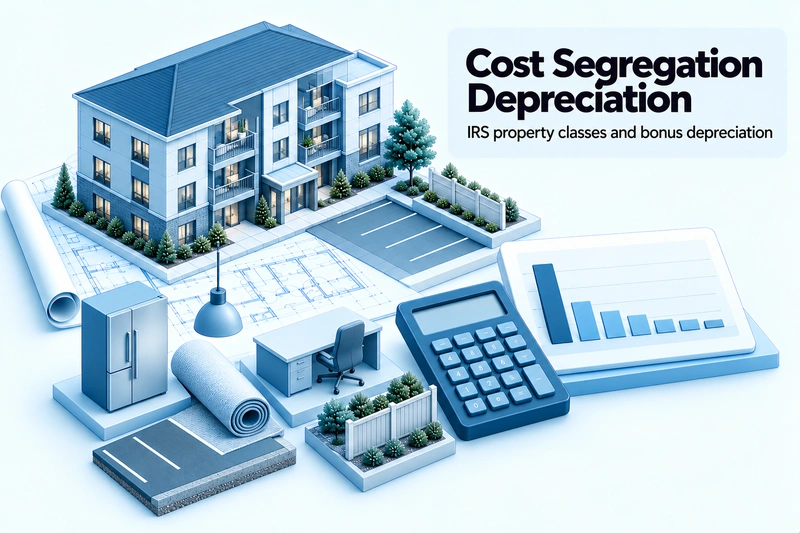
The two strategies address different halves of the same project. The election clears the basis of a disposed portion of a larger asset. A cost segregation study classifies what you installed.
A study completed before renovation can also distinguish whole-asset dispositions from partial dispositions. If carpet, appliances, or 15-year site improvements are already tracked as separate assets, retiring the entire separate asset generally produces a whole-asset disposition without a PAD election, subject to any applicable general asset account rules. The PAD election matters when the removed component is still part of a larger asset, such as the 39-year building account.
Sequence it as follows. Elect the partial disposition on the removed components. Study the renovation to identify 5-, 7-, and 15-year property in the new work. Apply bonus depreciation to the short-life assets.
The One Big Beautiful Bill Act made 100% bonus depreciation permanent. The Instructions for Form 4562 state that P.L. 119-21 "reinstated the 100% special depreciation allowance for certain qualified property acquired and placed in service after January 19, 2025." Both acquisition and placed-in-service timing matter. Written binding contracts and self-construction rules can affect the acquisition test; the contract-signing date is not automatically controlling. Ordinary qualifying property acquired before January 20, 2025 generally remains on the legacy track: 60% if placed in service in 2024, 40% in 2025, 20% in 2026, and 0% after 2026. Certain long-production-period property and aircraft follow a one-year-delayed legacy schedule. A transitional election permits a 40% allowance, or 60% for the specified long-production-period property and aircraft, for qualifying property placed in service during the first tax year ending after January 19, 2025.
Treasury and the IRS have since issued Notice 2026-11 on the permanent 100% deduction. Our full bonus depreciation guide walks through the mechanics.
Qualified Improvement Property carries a 15-year recovery period and qualifies for bonus depreciation. It covers interior improvements to nonresidential buildings placed in service after the building itself. It excludes building enlargements, elevators and escalators, and the internal structural framework.
Section 179 is a separate lever. For tax years beginning in 2025, the 2025 Instructions for Form 4562 set the maximum deduction at $2,500,000, reduced dollar for dollar above $4,000,000 of qualifying placements. For tax years beginning in 2026, Revenue Procedure 2025-32 raises those amounts to $2,560,000 and $4,090,000, respectively. Eligible qualified real property can include roofs, HVAC, fire-protection and alarm systems, and security systems installed in nonresidential real property. Two limits matter: §179 requires qualifying active trade-or-business use, and the deduction is limited by taxable income from active trades or businesses.
State conformity is a separate calculation. California does not follow federal bonus depreciation. The Franchise Tax Board states that California "specifically does not conform to the special allowance rules for bonus depreciation" in its Summary of Federal Income Tax Changes for P.L. 119-21. Check your state before you model the savings.
What disqualifies or limits a claim
- Full-structure demolition. §280B controls. No deduction.
- Property in a general asset account. A GAA election generally forecloses the partial disposition election for that property.
- Fully depreciated components. No remaining basis means nothing to deduct.
- Repair-versus-improvement trade-off. Under §1.263(a)-3(k)(1)(i), taking a loss on a disposed component generally requires capitalizing its replacement as a restoration. If the replacement would otherwise qualify as a currently deductible repair, electing a PAD loss can convert that replacement expenditure into a capital improvement. Compare the disposed-basis deduction with the loss of the immediate repair deduction before electing.
- Weak basis support. Using current replacement cost without discounting it back, or allocating without stated methodology, invites adjustment.
- Loss limitations. A deduction is not the same as a refund.
That last point decides whether any of this reaches your bank account. Passive investors are limited by the passive activity loss rules of §469, and suspended losses carry forward until you have passive income or dispose of the activity. Non-corporate taxpayers also face the §461(l) excess business loss cap, applied after basis, at-risk, and passive-activity limits. For 2026, the thresholds are $256,000, or $512,000 for a joint return, under Revenue Procedure 2025-32. Disallowed excess business losses generally become net operating loss carryforwards. Investors who qualify as real estate professionals under §469(c)(7) and materially participate can offset ordinary income. Our guide to real estate professional status covers the hour tests.
What if I cannot determine the exact original cost of removed components?
The regulation contemplates estimation. Choose one of the permitted methods, document the inputs and the reasoning, and apply it consistently across similar components. For material amounts, have an engineer prepare the allocation so the file stands on its own.
One benefit that is easy to miss
Making the election also changes how you treat the demolition invoice. Under Treas. Reg. §1.263(a)-3(g)(2)(i), removal costs become currently deductible once you elect the partial disposition. Capitalize them by default and you forfeit a same-year deduction on labor you already paid for.
Implementation checklist
- Before demolition: photograph every area scheduled for work and inventory the walls, systems, fixtures, and finishes coming out.
- During the project: require itemized contractor invoices by component category and keep disposal receipts.
- At allocation: pick a permitted basis method, document it, and confirm the building stays in service.
- At filing: report the loss on the original return for the year of disposal, including extensions. Treat the extended due date as a hard deadline.
- For prior years: check whether any return is still unfiled. Closed years are generally lost.
Whether to commission a study is a judgement call between you and your CPA. The test is whether the projected savings meaningfully exceed the fee, not a fixed property value. A $100,000 disposed basis is worth $37,000 at a 37% marginal rate, which frames the comparison.
See what your last renovation left behind
If you renovated a property this tax year, the basis of everything you removed is still sitting on your depreciation schedule. The window to claim it closes with your extended filing deadline.
Request a renovation basis review and find out what the components you tore out are worth.