Own a building that never got a cost segregation study? The depreciation you could have claimed is not lost. You also do not have to amend a stack of old returns to get it.
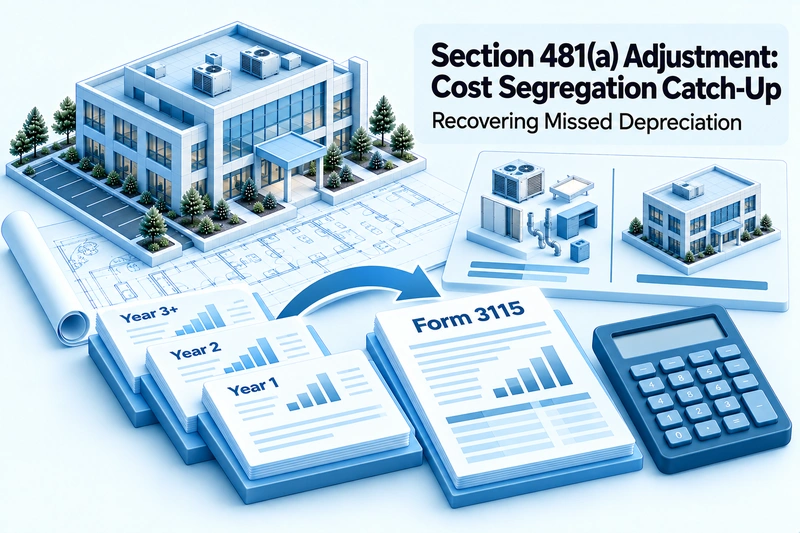
A Section 481(a) adjustment lets you correct the depreciation method on a property you already own and take the entire catch-up deduction on one current-year return. You make the change on Form 3115, Application for Change in Accounting Method.
This guide covers how the adjustment is computed, who actually qualifies, what it is worth, and the limits that decide whether you can use the deduction this year.
Key takeaways
- A negative Section 481(a) adjustment reduces income and is deducted entirely in the year of change; a positive adjustment increases income and is generally spread over four years (IRS Internal Revenue Manual 4.11.6).
- Form 3115 applies only to depreciable property you owned at the beginning of the year of change, so it is not the right tool for a property you bought this year (Instructions for Form 3115).
- The adjustment recomputes each prior year under the rules that applied then. It does not apply today's 100% bonus rate to a 2021 building.
- The permanent 100% bonus rate under the One Big Beautiful Bill turns on the acquisition date. Property must be acquired after January 19, 2025, not merely placed in service after that date (IRS guidance on the OBBB first-year depreciation deduction).
- A large catch-up deduction is only worth cash today if you can actually use it. The passive activity loss rules suspend it for many investors.
What a Section 481(a) adjustment does
Section 481(a) reconciles a change in accounting method so that income and deductions are neither duplicated nor omitted. Reclassifying building components through cost segregation changes your method of accounting for depreciation. That change needs IRS consent, which you obtain by filing Form 3115.
The adjustment equals the cumulative difference between the depreciation you actually claimed and the depreciation you were allowed to claim under the corrected method, measured as of the first day of the year of change. Because it is one cumulative figure, it can reach back past the refund statute of limitations, which runs three years from filing or two years from payment, whichever is later (26 U.S.C. §6511).
Do I need to rebuild depreciation year by year?
Your preparer does the year-by-year math internally, but you file one number. The computation runs on Schedule E of Form 3115 and covers every year from the placed-in-service date through the beginning of the year of change.
Positive and negative adjustments are not what they sound like
The IRS sign convention is the opposite of what most people assume, and getting it backwards will confuse any conversation with your CPA.
- A negative adjustment reduces taxable income. This is the favorable cost segregation catch-up, and it is taken entirely in the year of change.
- A positive adjustment increases taxable income. It is generally spread ratably over four years, beginning with the year of change. You may elect a one-year period if the positive adjustment is under $50,000.
If you previously over-claimed depreciation, your adjustment is positive, and you will owe additional tax spread over four years unless you elect otherwise.
Who actually qualifies
This is where most articles overpromise. Three conditions matter.
You owned the property at the beginning of the year of change. The automatic change for depreciation (designated change number 7) applies to property "owned at the beginning of the year of change." A building you placed in service this year does not qualify.
A method has been established. Depreciation generally becomes an established method of accounting once you have used it on two consecutive filed returns. If you have filed only one return, amending that return is usually the correct route, not Form 3115.
You are eligible under the automatic procedures. Rev. Proc. 2015-13 restricts repeat changes for the same item within a five-year window, among other conditions. Your CPA should confirm eligibility before you file.
Within those limits, holding period is not a barrier. A property held for fifteen years generates a larger adjustment than one held for three, because the depreciation gap has compounded.
Can I use this if I've owned the property for 10 years?
Yes. The adjustment captures the cumulative difference from the placed-in-service date forward, and there is no lookback cap. Longer holds generally produce larger adjustments.
Form 3115 versus amending returns
Amending reaches back three years and requires a separate return for each year, plus any state equivalents. You also wait for processing, the IRS asks taxpayers to allow 8 to 12 weeks for a Form 1040-X, and up to 16 weeks in some cases (Where's My Amended Return).
Form 3115 collapses all of that into one attachment to a return you were filing anyway. The deduction lands on the current year. There is a third path worth knowing: for a property you just placed in service, you simply apply cost segregation on the original return and file nothing extra.
One advantage rarely mentioned is audit protection. Under the automatic change procedures, the IRS generally will not challenge your prior-year use of the improper method for years before the year of change. Amending gives you no equivalent protection.
A worked example
An office building placed in service in July 2018, with $2,000,000 of depreciable basis after excluding land value. It was depreciated over 39 years. A study reclassifies 30% to 5-year property and 15% to 15-year property. Assume the shorter-life assets met the 2018 acquisition and eligibility requirements and that the taxpayer did not elect out of bonus depreciation for either class. Under those assumptions, 100% bonus depreciation was allowable in 2018. If the 2018 return included a valid election out for the 5- or 15-year class, the catch-up calculation instead uses regular MACRS for that class; Form 3115 does not by itself revoke that election.
| Line | Amount |
| Depreciable basis | $2,000,000 |
| 5-year property (30%) | $600,000 |
| 15-year property (15%) | $300,000 |
| 39-year property (55%) | $1,100,000 |
| Depreciation actually claimed, 2018–2024 (39-yr SL, mid-month) | $331,196 |
| 2018 bonus on $900,000 of 5- and 15-year property at 100% | $900,000 |
| 39-year depreciation on $1,100,000, 2018–2024 | $182,158 |
| Total depreciation allowable | $1,082,158 |
| Negative §481(a) adjustment | $750,962 |
At a 37% marginal rate (the top individual bracket, not a default), the deduction is worth roughly $277,900 in federal tax if it is currently usable. Your own figures will differ with acquisition date, land allocation, component mix, and bonus rate.
The limits that decide whether you can use the deduction
A catch-up deduction is only cash in hand if the loss clears four separate gates. Skipping this section is the most common reason an investor is disappointed by an otherwise correct study.
Passive activity losses. Rental activity is passive by default. Passive losses offset passive income, and the excess is suspended until you have passive income or dispose of the activity (IRS Publication 925). A $750,000 catch-up deduction can produce $0 of current-year benefit for a purely passive investor. A taxpayer who qualifies for real estate professional status must also materially participate in each rental activity, unless making the election under Treasury Regulation Section 1.469-9(g) to treat all rental real estate interests as one activity and materially participating in that combined activity. Status alone does not make rental losses nonpassive. A short-term lodging activity outside the rental definition also requires material participation for its losses to be nonpassive.
Excess business loss limitation. Section 461(l) caps the net business loss a noncorporate taxpayer can use against other income in a year, after basis, at-risk, and passive-activity limits. For 2026, the thresholds are $256,000, or $512,000 for a joint return, under Revenue Procedure 2025-32. Disallowed excess business losses generally become net operating loss carryforwards (About Form 461).
Basis and at-risk limits. In a partnership or S corporation, your deductible share is capped by outside basis and by amounts at risk. Two partners in the same deal can get very different answers.
It is a timing benefit. Accelerated depreciation reduces basis. You are moving deductions forward, not creating new ones, and you pay part of it back on exit.
Bonus depreciation: acquisition date, not filing date
A 481(a) adjustment never changes the bonus rate. It recomputes each prior year under that year's rules. The rate is fixed by when the property was acquired and placed in service.
The One Big Beautiful Bill, signed July 4, 2025, restored a permanent 100% allowance for qualified property acquired after January 19, 2025 and placed in service after that date (Instructions for Form 4562). Ordinary qualifying property acquired before January 20, 2025 generally remains on the legacy phase-down schedule: 40% if placed in service in 2025, 20% in 2026, and 0% after 2026. Certain long-production-period property and aircraft follow a one-year-delayed legacy schedule (IRS Publication 946).
That distinction has teeth. A building placed under binding contract in December 2024 and closed in March 2025 is 40% property, not 100% property, even though it was placed in service well after January 19.
| Acquired and placed in service | Bonus rate |
| 2018–2022 | 100% |
| 2023 | 80% |
| 2024 | 60% |
| Acquired before Jan 20, 2025; placed in service in 2025 (ordinary qualifying property) | 40% |
| Acquired before Jan 20, 2025; placed in service in 2026 (ordinary qualifying property) | 20% |
| Acquired before Jan 20, 2025; placed in service after 2026 (ordinary qualifying property) | 0% |
| Acquired and placed in service after Jan 19, 2025 | 100%, permanent |
Section 168(k)(10) also permits a transitional election for qualifying property placed in service during the first tax year ending after January 19, 2025: 40% instead of 100%, or 60% for the specified long-production-period property and aircraft. This election is distinct from electing out of bonus depreciation by property class.
For current acquisitions, the permanent 100% bonus rules make a study at purchase the cleaner play. See our coverage of the One Big Beautiful Bill for the full provision.
Filing mechanics
Automatic changes are made under the current annual list of automatic changes. That list is reissued roughly every year: Rev. Proc. 2022-14 was superseded by Rev. Proc. 2023-24, then Rev. Proc. 2024-23, then Rev. Proc. 2025-23 (BDO summary). Confirm the governing procedure for your year of change rather than relying on any article, including this one. Automatic consent means no advance approval and no user fee.
Two filing steps, not one. Attach Form 3115 to your timely filed return, including extensions, for the year of change, and file the duplicate copy separately as the current revenue procedure directs. Filing only the return copy is a common and avoidable failure. Limited relief for a late automatic change may be available under Treas. Reg. §301.9100-2, but do not plan around it.
The form requires a description of the change, the 481(a) computation, and supporting schedules from the study.
Documentation that holds up
The IRS Cost Segregation Audit Techniques Guide is an examiner aid rather than binding guidance. It does not mandate one methodology. It sets out thirteen principal elements of a quality study and identifies the detailed engineering approach from actual cost records as the most accurate. Studies built on rules of thumb rather than property-specific analysis draw the most scrutiny.
Keep the study report, component listings, depreciation schedules, cost substantiation, and photographs from the site visit, whether virtual or in person.
What should my study include?
A property-specific component breakdown, a documented cost basis for each class, a stated methodology, and a preparer with construction or engineering experience. No license is legally required, but experience is the factor examiners weigh.
Related moves worth coordinating
When you renovate, the partial disposition election lets you write off the remaining basis of a component you removed instead of depreciating a roof you no longer own. It is normally made on the timely filed return for the year of the disposition, so plan it before year end, relief for late elections is narrow.
On exit, plan for recapture. Reclassified Section 1245 assets generally produce ordinary-income recapture to the extent of depreciation allowed or allowable, limited by gain. Fifteen-year land improvements classified as Section 1250 property can also produce ordinary-income recapture: bonus depreciation exceeding straight-line depreciation is additional depreciation under Section 1250. In the example, the $300,000 of 15-year property receives 100% bonus, making this distinction material to the exit calculation. Straight-line depreciation on the building, and the eligible straight-line portion on improvements, can instead produce unrecaptured Section 1250 gain taxed at a maximum 25% rate for individuals (IRS Publication 544).
Depreciation classification and exchange eligibility are separate tests. Many components treated as Section 1245 property in a study may qualify as real property for Section 1031 under Treasury Regulation Section 1.1031(a)-3; movable furniture and equipment generally do not. Even when the relinquished components qualify as exchangeable real property, Section 1245(b)(4) can trigger Section 1245 recapture to the extent the replacement property does not contain sufficient Section 1245 property, even if no boot is received. Model the replacement asset mix rather than describing every recapture exposure as taxable boot.
Will a large adjustment trigger an audit?
We have no data showing that Form 3115 filings raise audit rates, and we will not claim otherwise. What we can say is that a properly filed method change is a routine, procedurally sanctioned transaction, and that a documented engineering-based study is what substantiates it if questions arise.
State treatment varies
Federal and state answers often diverge. Some states do not allow bonus depreciation. Some use a fixed conformity date and have not adopted recent federal changes. Some require their own method-change filing or a separate depreciation schedule. The state effect can be zero, or negative in a decoupled state where you add the federal bonus back. Price the federal and state outcomes separately with your CPA.
What to do next
Pull the depreciation schedules for every property you owned on January 1 of this year. Flag any that were placed in service in an earlier year, have meaningful depreciable basis, and have never had a study. Those are your 481(a) candidates.
Then answer the gating question before you spend anything: given your participation level and income, can you use the deduction this year, or will it sit suspended? If the answer is unclear, that conversation with your CPA is worth more than any estimate.
When you are ready to size the opportunity, run your numbers with the cost segregation calculator or request a preliminary analysis of your portfolio through our cost segregation services.