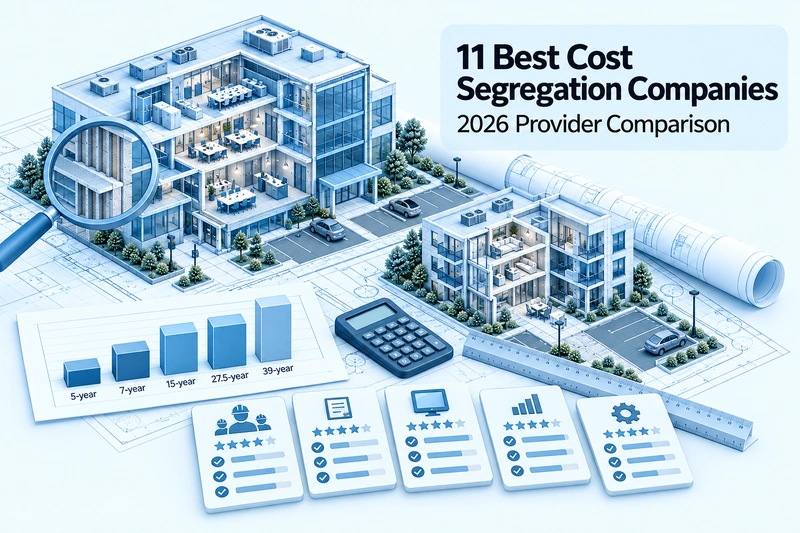
The best cost segregation company for most investors is a provider that combines engineering-based analysis, clear documentation, responsive CPA support and an engagement scope matched to the property. There is no single winner for every situation.
R.E. Cost Seg is a strong fit for investors who want a choice between a lower-cost, engineer-reviewed residential report and a fully engineered study. KBKG, CSSI, Madison SPECS and Engineered Tax Services are established specialty providers suited to full-service studies. CostSegregation.com is the clearest self-service option for qualifying properties below its stated basis limit. Kroll, BDO, CohnReznick and Deloitte may make more sense when cost segregation is one part of a broader enterprise tax, valuation or advisory engagement. McGuire Sponsel is positioned between those groups, with a specialty-tax and CPA-partnership model.
Editorial note: We reviewed each provider’s publicly available website and service information in September 2026. Offerings, pricing and eligibility can change. “Best” depends on the property, desired service level, tax situation and the quality of the final scope, not simply the highest projected deduction. This article is educational and is not tax, legal or accounting advice.
Quick comparison
How we evaluated these cost segregation providers
This comparison focuses on information a property owner can reasonably verify before requesting a proposal:
- Study model: self-service software, engineer-reviewed model or fully engineered engagement
- Property fit: smaller residential assets, commercial properties, portfolios or enterprise projects
- Methodology and documentation: how the provider describes inspections, cost estimation and asset classification
- Tax and CPA support: whether the team coordinates with tax professionals or offers broader fixed-asset expertise
- Audit support: what support is described and whether important exclusions are disclosed
- Transparency: public pricing, thresholds, timelines and scope limitations
- Related capabilities: look-back studies, Form 3115 support, repair regulations, partial dispositions and other tax services
We did not rank providers by the largest advertised deduction. A more aggressive allocation is not automatically a better study. The goal is a supportable result that fits the property facts and can be implemented correctly by the taxpayer’s tax advisor.
1. R.E. Cost Seg: best for investors who want flexible study options
R.E. Cost Seg offers two clearly differentiated services. Its Rapid Report is an engineer-reviewed, self-directed option for qualifying residential properties, while its Fully Engineered Study is available for residential and commercial real estate without a stated maximum property value.
The company publicly lists the Rapid Report from $950. Its fully engineered service starts at $2,320 for residential properties and $2,730 for commercial properties, with the final fee based on scope and complexity. Fully engineered studies can use virtual or in-person inspections and include detailed component measurements and cost assignments. The company also states that audit support is included, while clearly explaining that this does not mean legal representation before the IRS or defense of tax positions outside its report.
R.E. Cost Seg stands out for giving investors a practical step-up path: a smaller qualifying residential asset may fit the Rapid Report, while a larger, unusual or commercial property can move to a full engineering engagement. Published standard timelines are approximately 5–10 business days for Rapid Reports and 15–20 business days for fully engineered studies after required information is received.
Client feedback often emphasizes communication, turnaround and ease of working through a virtual process. Investors comparing providers can read R.E. Cost Seg reviews and client results before requesting a proposal.
Best fit: Residential or commercial investors who value transparent options, remote-friendly inspections, CPA-ready schedules and included audit support.
Consider another option if: You want a global advisory firm to combine the study with a large transaction, valuation or multinational tax engagement.
2. Kroll: best for institutional and complex real estate engagements
Kroll provides cost segregation through its Real Estate Advisory Group. Its public service list goes beyond a standard single-property study and includes look-back studies, repair-regulation analysis, asset scrubs, IRS-based statistical sampling, investment tax credit cost segregation, REIT-specific work and audit defense.
That breadth makes Kroll a logical candidate for institutional owners, REITs, private equity sponsors and businesses with large fixed-asset populations. It may also be useful when cost segregation needs to connect with valuation, transaction or real estate advisory work.
Best fit: Large portfolios, specialized property types, REITs and organizations needing cost segregation inside a broader advisory engagement.
Consider another option if: You own one straightforward rental and want transparent entry-level pricing or a lightweight process.
3. BDO: best for multidisciplinary tax and capital-investment planning
BDO offers cost segregation analysis within its capital investment credits and incentives practice. The firm describes a multidisciplinary team of specialized engineers, construction specialists, site-selection professionals and tax professionals.
This integrated model may appeal to companies already using BDO or those evaluating cost segregation alongside broader federal, state and local incentives. BDO also provides a cost segregation analysis calculator intended to identify construction-related assets that may qualify for accelerated or bonus depreciation.
Because the service sits inside a national accounting and advisory platform, public-facing information is less focused on a standardized standalone study package than specialist providers’ websites.
Best fit: Businesses that want cost segregation integrated with wider capital-investment, incentives or tax planning.
Consider another option if: Your priority is a simple online purchase, published per-study pricing or a provider focused almost exclusively on cost segregation.
4. CostSegregation.com: best self-service software for qualifying smaller properties
CostSegregation.com is a self-guided platform powered by KBKG. It is designed for supported residential and commercial properties with a depreciable tax basis of up to $1.5 million, excluding land.
The workflow uses property data and user inputs to generate a report in minutes. Publicly listed features include AI-assisted data collection, a land-versus-building allocation advisor, a catch-up adjustment schedule for Section 481(a), report corrections, and audit support. The site lists residential pricing from $495 and commercial pricing that varies with basis, including a displayed $1,295 example at a $1 million basis.
The main trade-off is also clear: this is software, not an on-site engineering engagement. The company’s FAQ states that no site visit is included. A standardized model may work well for a typical qualifying property but may not be the right tool for a complex renovation, unusual building systems, incomplete records, or a basis above the platform limit.
Best fit: Hands-on owners and tax professionals seeking a fast, lower-cost report for a supported, relatively straightforward property.
Consider another option if: The property exceeds the stated basis limit, has unusual construction, or would benefit from an individualized inspection and full engineering analysis.
5. KBKG: best for full-service specialty tax depth
KBKG is the parent company behind CostSegregation.com and also performs full-service cost segregation studies. Its process describes reviewing available cost records and blueprints, conducting a physical inspection, and estimating component values when detailed records are unavailable.
KBKG’s broader tax-specialty platform includes repair-versus-capitalization analysis, partial disposition tools, Section 45L and 179D services, R&D tax credits and other incentives. That can be useful to CPAs and owners who want a team familiar with how cost segregation interacts with other fixed-asset tax issues.
The distinction between KBKG and CostSegregation.com matters: the website and software serve different property profiles and service expectations. Investors should confirm which product is being proposed and what inspection, engineering, and audit support are included.
Best fit: Owners, companies and CPA firms that want a national specialty-tax provider with both full-service and software capabilities.
Consider another option if: You want the simplest low-cost self-service workflow; in that case, evaluate CostSegregation.com directly.
6. CSSI Services: best for a scaled engineering-based process
CSSI Services markets an engineering-based, three-stage process: a no-cost preliminary analysis, an engineering study, and implementation support with the client’s CPA or tax professional. The company says its engineers conduct an on-site inspection and evaluate more than 150 building components.
CSSI publishes substantial experience and savings figures on its website. Those numbers show scale, but investors should treat any average or case study as illustrative. Actual allocations and tax outcomes depend on the building, depreciable basis, in-service date, tax rate, activity-loss rules, and other taxpayer-specific facts.
Best fit: Owners looking for an established national engineering provider with on-site inspection and CPA coordination.
Consider another option if: You need a self-service product with an immediate report and fixed online pricing.
7. Madison SPECS: best for larger projects and on-site engineering
Madison SPECS is a cost segregation specialist affiliated with the Madison family of real estate companies. It emphasizes on-site inspections by in-house engineers, a national footprint and coordination with CPAs.
The firm offers a no-cost feasibility analysis and says it will tell an owner when a study is unlikely to provide enough benefit. Its website frames ideal candidates as investment properties worth at least $1 million or renovations of at least $750,000, with a planned holding period of at least three years. Those are the company’s screening guidelines rather than universal tax-law thresholds.
Madison’s integrated real estate relationships and in-house team may be attractive to owners with larger projects, portfolios or repeat study volume.
Best fit: Larger acquisitions, renovations and portfolios where a traditional site tour and a specialized national team are priorities.
Consider another option if: You have a smaller residential asset and want a lower-cost software or streamlined report option.
8. Engineered Tax Services: best for broad specialty-tax coverage
Engineered Tax Services is a licensed engineering and specialty-tax firm that serves both residential investment and commercial properties. Its cost segregation offering sits alongside R&D tax credits, Section 179D, 1031 exchange services and other tax and incentive work.
ETS describes an engineering-based process, nationwide coverage and property-specific studies rather than a one-size-fits-all report. Its website also provides calculators, case studies and guides across many property types.
As with any provider publishing average savings or reclassification ranges, those figures should be treated as examples, not promises. Ask for a property-specific feasibility estimate, project scope and explanation of who performs and reviews the work.
Best fit: Investors and businesses that want an engineering firm capable of addressing cost segregation alongside other specialty-tax opportunities.
Consider another option if: You prefer a narrower provider or need a clearly priced self-service report for a small property.
9. McGuire Sponsel: best for CPA-coordinated specialty tax work
McGuire Sponsel performs cost segregation within its Fixed Asset Services practice. The firm emphasizes the CPA-client relationship and says every study receives a site inspection, with costs and classifications documented to support the analysis.
Its website identifies typical strong candidates as acquisitions or new construction above $750,000, interior renovations above $200,000, businesses with large fixed-asset schedules and companies that renovate frequently. The firm also offers related fixed-asset, incentives, R&D and global business services.
Best fit: CPA firms and clients who want cost segregation delivered through a specialty-tax partnership model, especially for larger or recurring fixed-asset projects.
Consider another option if: You have a low-basis property or want a self-directed software experience.
10. CohnReznick: best for real estate operators needing integrated advisory
CohnReznick combines engineers and tax professionals, including professionals with tax-technical and construction experience, for cost segregation and fixed-asset studies. Its broader real estate platform includes accounting, tax, technology, valuation and operational advisory services.
The firm says a study may generate significant tax deferral when a property costs more than $2 million, the owner plans to retain it for at least two years or the taxpayer can otherwise benefit from accelerated depreciation. Again, that is a practical screening guideline, not a legal minimum.
CohnReznick may be especially relevant for developers, funds, portfolio operators and existing clients that want cost segregation connected to a larger real estate tax and reporting strategy.
Best fit: Real estate organizations that value integrated accounting, tax, valuation and operational advice.
Consider another option if: You want a standalone study for a small property with simple public pricing.
11. Deloitte: best for complex enterprise tax needs
Deloitte is a global professional services organization with extensive tax, engineering, valuation and real estate capabilities. Cost segregation may be available as part of broader depreciation, capital-recovery or real estate tax work, but Deloitte’s U.S. public website provides less detail on a standardized standalone cost segregation package than the specialist firms in this comparison.
That does not make Deloitte a weak provider; it means the buying process is likely to be engagement-led rather than product-led. Large companies may value the ability to coordinate cost segregation with transaction, accounting-method, international, technology or industry-specific work. Smaller owners may find a specialist easier to scope and compare.
Best fit: Large or multinational organizations with complex tax, transaction and advisory requirements.
Consider another option if: You need transparent entry-level pricing, a rapid residential report, or a narrowly defined standalone engagement.
How to choose the right cost segregation company
1. Match the study type to the property
A standardized software report may be cost-effective for a typical smaller rental. A complex hotel, manufacturing facility, large renovation, or mixed-use property may warrant a full engineering study with an inspection and detailed cost analysis.
2. Ask who actually performs and signs the study
Confirm the qualifications of the people collecting property data, estimating component costs, classifying assets, and reviewing the final report. “Engineering-based” should describe the actual work, not just the company’s marketing.
3. Compare scope, not only price
A useful proposal should explain:
- Whether the inspection is on-site, virtual, or not included
- Which documents the provider reviews
- Whether renovation costs and indirect costs are analyzed
- What depreciation schedules and workpapers are delivered
- Whether CPA questions, report corrections and Form 3115 support are included
- Exactly what “audit support” covers and excludes
- The expected turnaround after all information is received
4. Be cautious with guaranteed outcomes
No reputable provider can guarantee a deduction before analyzing the property and the taxpayer’s facts. A study identifies and documents depreciation classifications; the taxpayer’s ability to use the resulting deductions depends on tax basis, placed-in-service dates, entity structure, passive activity rules, at-risk limitations and other factors.
5. Involve your tax advisor early
The cost segregation company prepares the study, but your CPA or tax advisor implements it on the return. Confirm that your advisor agrees with the timing, understands the provider’s deliverables and can address any accounting-method change that may be required.
Why cost segregation matters more under 100% bonus depreciation
Cost segregation separates qualifying shorter-life components from a building’s 27.5- or 39-year recovery period. Property with a MACRS recovery period of 20 years or less may qualify for bonus depreciation when all statutory requirements are met.
The One Big Beautiful Bill Act permanently restored 100% additional first-year depreciation for eligible property acquired and placed in service after January 19, 2025. Timing rules, acquisition rules, elections and state conformity can complicate the result, so property owners should not assume every reclassified dollar receives the same treatment.
A cost segregation study does not create a new deduction or make land depreciable. It determines the proper tax classification and timing of eligible property costs.
Frequently asked questions
What is the best cost segregation company in 2026?
There is no universal best provider. R.E. Cost Seg offers a strong balance of flexible service levels and transparent starting prices. CostSegregation.com is attractive for qualifying owners who want self-service software. KBKG, CSSI, Madison SPECS and Engineered Tax Services are established full-service specialists. Kroll, BDO, CohnReznick and Deloitte are better suited to many enterprise or multidisciplinary engagements.
How much does a cost segregation study cost?
Software reports can start below $500, while engineer-reviewed or fully engineered studies commonly cost more and depend on property size, type, basis, records, inspection needs and complexity. Compare the included scope and expected net tax benefit, not the fee alone.
Is cost segregation software the same as an engineering study?
No. Software generally relies on standardized models and owner-provided inputs. A fully engineered study can include property inspection, document review, quantity takeoffs and individualized cost assignments. Either model may be appropriate depending on the property and risk profile.
Does the IRS require an on-site visit?
Tax law does not impose a simple rule that every study must include an on-site visit. However, the IRS Cost Segregation Audit Technique Guide treats field inspection as an important quality consideration. A provider should explain how it verifies the property’s components and use when an in-person visit is not performed.
Can I do a cost segregation study on a property bought in a prior year?
Often, yes. A look-back study may allow a taxpayer to catch up missed depreciation through an accounting-method change, commonly involving Form 3115 and a Section 481(a) adjustment, rather than amending every prior return. Ask a qualified tax advisor whether that approach applies.
Does cost segregation automatically reduce my taxes?
No. The study accelerates depreciation deductions, but the amount of current tax savings depends on whether the taxpayer can use those deductions. Passive activity loss rules, basis and at-risk limits, business use, tax rate and future disposition all matter.
What should a quality cost segregation report include?
A quality report should explain the property, methodology, assumptions, asset classifications, cost basis reconciliation and depreciation schedules. It should provide enough supporting detail for the taxpayer and tax advisor to understand and defend the conclusions.
Final takeaway
Choose the cost segregation provider whose process fits the property, not the one promising the largest headline write-off. For a smaller, straightforward asset, a transparent software or streamlined report may produce the best return on cost. For a complex building, renovation or portfolio, deeper engineering and tax expertise may justify a larger engagement. In every case, insist on clear scope, supportable classifications, usable deliverables and coordination with your tax advisor.
Relationship disclosure: BonusDepreciation.com was launched by R.E. Cost Seg as an educational platform, and its bonus depreciation calculator is powered by R.E. Cost Seg. R.E. Cost Seg is therefore an affiliated provider in this comparison, not an unaffiliated third party. Readers should consider that relationship when evaluating its placement and description. The same published evaluation criteria have been applied to every provider, and any paid, referral, or affiliate arrangement connected to a link should be identified clearly where applicable.